
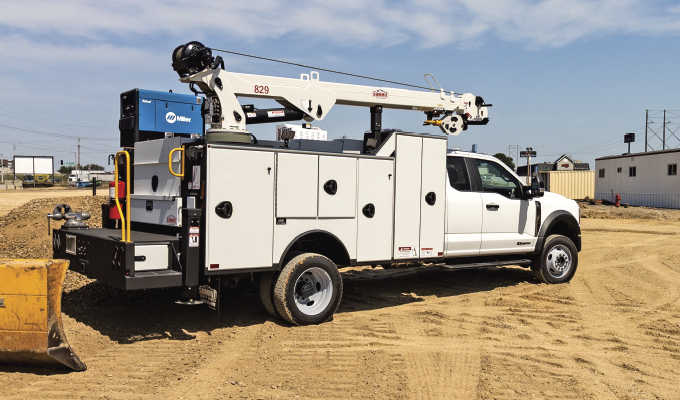
When a piece of construction equipment goes down, the service truck becomes more than transportation. Its crane may allow a technician to remove a failed component, complete the repair and return the machine to work without moving it from the jobsite.
Selecting the right crane; however, requires more than choosing the highest capacity rating. That number doesn’t show how much the crane can lift at the load radius the technician will use, what chassis the installation requires, or how much payload remains on a fully equipped truck. Too little capacity can lead to rental costs, additional trucks and longer repairs. Too much may add cost and weight while leaving less capacity for tools, parts and supporting equipment. Right-sizing begins with understanding the work and evaluating the crane, body and chassis as one complete system.
START WITH THE WORK
Before comparing crane models, fleet managers need a clear picture of the work the truck will perform.
“What is the heaviest pick you will have on a regular basis? How far away from the truck will you be lifting the load? Will every truck be lifting the same loads?” says Nick Schafer, territory sales representative for Summit Truck Equipment.
Start by identifying the equipment your technicians service and the components they lift most often.Document the weight of those components, their typical load radii and how frequently the lifts occur.
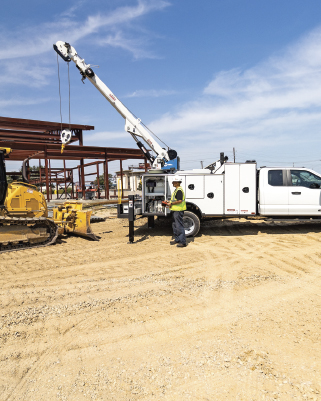
Actual working distance matters. A component that can be lifted with the truck parked nearby creates a different requirement than one beyond an obstacle or in an area with limited access. Fleets should consider truck positioning, stabilizer clearance, terrain, overhead obstructions and other jobsite conditions.
Technicians and service managers can offer insights that may not be reflected in fleet records. Inquire about which jobs require rented equipment, an additional crane-equipped truck, or a different repair method because the current crane is unable to complete the lift. These situations may highlight a recurring capability gap.
Fleets should also distinguish regular work from an exceptional lift. Repeatedly renting equipment may indicate that a larger crane would improve productivity. Specifying every truck around a rare worst-case scenario, however, can add weight and cost that provide little everyday value.
Not every truck will need the same capacity or reach. Define a realistic range of loads, load radii, operating frequency and site conditions for each application. That is a more useful starting point than simply asking for the largest crane the chassis can carry.
READ THE ENTIRE LOAD CHART
Maximum lifting capacity is often the first number fleet managers compare, but it represents only one point on the load chart. That capacity is available under a specific configuration and at a specified load radius. It does not remain constant throughout the crane’s reach.
“What it says on the side of the crane can be misleading,” says Daniel De Aces, national sales manager for Summit Truck Equipment. “Several manufacturers offer a 12,000-pound crane, but a careful review of the load chart shows that not all 12,000-pound cranes are the same. One may lift 12,000lbs at a four-foot load radius, while another may achieve that capacity at six feet.”
Load radius is the horizontal distance from the crane’s center of rotation to the center of the suspended load. As that distance and the leverage placed on the crane increase, available capacity generally decreases. A fleet that regularly lifts a 3,000lbs component at an 18’ load radius should compare capacities at 18’, not choose solely by maximum ratings.
Fleet managers should also distinguish maximum horizontal reach from the boom’s physical length. Horizontal reach is measured from the center of rotation to the vertical hoist line or center of the load. Part of the boom may extend beyond that point, and capacity at maximum reach will be considerably lower than maximum lifting capacity.
The chart may also identify differences based on boom extension, boom angle, line configuration or operating zone. The final installation may include separate stability information for the truck, body, outriggers and mounting configuration. Electronic load-management systems can assist the operator, but they do not replace the manufacturer’s charts, stability information or required measurements.
Place the fleet’s expected loads and load radii beside the corresponding capacities for each crane under consideration. This reveals whether a crane suits the work, rather than merely carrying the preferred number on its identification plate.
WEIGH THE COST OF TOO MUCH OR TOO LITTLE CRANE
Right-sizing is not simply about avoiding a crane that is too small. Both insufficient and unnecessary capacity can create costs throughout the truck’s service life.
When a crane cannot complete a required lift within its rated capacity, the technician may need another crane-equipped truck or rented lifting equipment. That adds coordination, labor and equipment costs and can extend machine downtime. If the same lift regularly requires outside support, the savings from selecting a smaller crane can quickly disappear.
An undersized crane can also limit the repair approach. If the load or required load radius falls outside its rated capacity, the technician may need to reposition the truck, change the plan or wait for properly sized equipment. Those limitations may not become apparent until the truck reaches the jobsite, when delays are more costly.
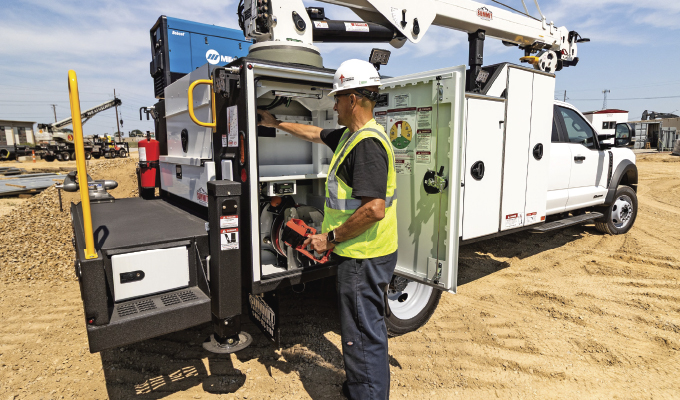
Additional capacity can provide flexibility, but it comes with trade-offs. A larger or heavier crane may require a higher-capacity chassis, more body reinforcement or larger stabilizer and bumper components. It also consumes payload that could carry tools, parts and materials. A larger chassis may increase acquisition, fuel, maintenance and insurance costs.
That does not make a larger crane the wrong choice when the work justifies it. Compare how often a proposed crane would fall short with the full cost of adding permanent capacity. Regular higher-capacity lifts may justify the investment through fewer delays and rentals. For a rare lift, outside equipment may be more economical than carrying unused capacity every day.
The best specification balances routine lifting requirements, anticipated changes in the fleet’s equipment and the total cost of operating the completed truck.
TREAT THE TRUCK AS ONE COMPLETE SYSTEM
A service-truck crane does not operate independently of the vehicle carrying it. Its weight, mounting location and support requirements affect the body and chassis before the first load is lifted. Crane selection must therefore be evaluated alongside the complete equipment package.
Gross vehicle weight rating is only part of that evaluation. Fleets must also consider axle ratings, side-to-side weight distribution and expected operating weight. A crane mounted near a rear corner creates a concentrated load, while tools, compressors, welders, fluids and parts add weight elsewhere. A truck may remain below its overall rating while overloading an axle or creating an undesirable imbalance.
The crane also influences service-body configuration. Its compartment may require additional structure, while larger stabilizers or bumper components add weight and consume mounting space. Supporting equipment competes for the same payload and space. A configuration that works on paper one component at a time may leave too little capacity for the technician’s everyday tools and materials.
Before ordering the chassis, fleets should give the upfitter a complete equipment list, estimated payload and intended application. The crane, body, chassis and supporting equipment can then be evaluated together, with time to adjust the specification. The goal is a truck that can carry, power and support the work without compromising weight distribution, payload or usability.
RIGHT-SIZE EACH TRUCK AND STANDARDIZE WHERE IT COUNTS
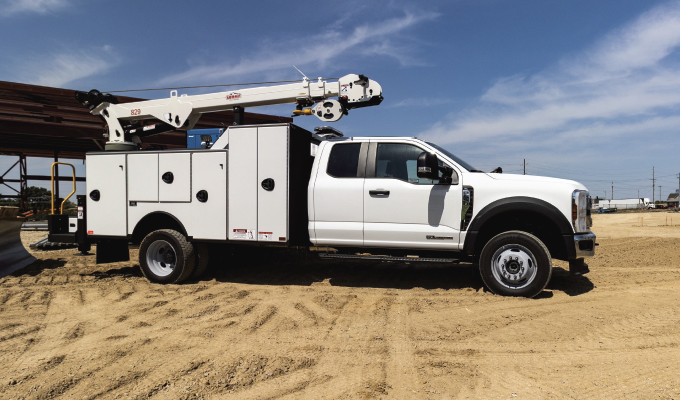
Right sizing a fleet does not mean putting the same crane on every truck. Different equipment, assignments and environments may require different capacities or reaches. Fleets can create consistency in the controls, safety functions and procedures technicians use.
Familiar controls and system responses can reduce the adjustment required when a technician moves between trucks. Consistency does not replace model-specific training or review of each load chart, but it can make transitions less disruptive.
“Having similar operating systems across the fleet means technicians are familiar with the controls,” says Shane Kimbrell, territory sales representative for Summit Truck Equipment. “When a truck goes down, and they have to switch trucks, there is less of a learning curve. Without that consistency, the learning curve may happen while thousands of pounds are in the air or being loaded into the cargo area.”
Where available, maintenance, diagnostic and usage data can help fleets evaluate crane use and improve the next specification cycle. Standardize the elements that support training and operation while allowing crane capacity and truck configuration to match each vehicle’s work.
BUILD THE SPECIFICATION FROM THE WORK OUTWARD
Right-sizing a service-truck crane is not about choosing the highest capacity or matching every truck in the fleet. It begins with the loads technicians handle, the load radii at which they lift and the conditions they encounter. The crane must then be evaluated with the chassis, body, payload and supporting equipment. By comparing complete load charts, accounting for lifecycle costs and standardizing the operator experience where practical, fleets can support the work without adding capacity, cost or complexity the application does not require.
about the author
Sondra Kirby is the marketing manager for Summit Truck Bodies and Summit Truck Equipment. She has worked in the work truck industry since 2013 and develops content in collaboration with the company’s engineering, sales and service teams. She holds an MBA in marketing from Maryville University.