
A customer came in a few weeks ago wanting a slide-out ramp that stowed in a cassette beneath the floor of his Ram ProMaster. He had seen the style on rental trucks and liked it. His crew included young women and retirees, and he worried a conventional ramp would be too heavy for them to manage.
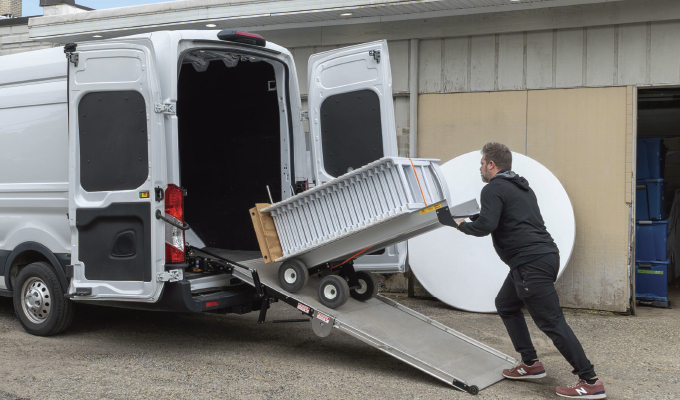
The build was a custom case under the van, an aluminum ramp, and special locking hardware, because a cassette that is not latched can slide out on the road. Then we showed him the alternative we had ordered on our own, a Link LB20 folding ramp with a gas spring, in a narrower width, offset to one side so it did not consume the back of the van. A 10-year-old opened it, folded it, and set it back in place. He is now converting his entire fleet.
That job explains how this work goes. The customer arrives with a solution in mind. The job itself usually wants something different.
START WITH QUESTIONS, NOT PRODUCTS
Before anyone at Medina Upfit recommends hardware, we want to know how the crew loads today. Are they lifting by hand? Has anyone been hurt doing it? Does the company cap what an employee may lift, which for a lot of fleets now sits around 50 pounds?
Then come the details that narrow it fast. How heavy is the load and does it roll? How many times a day does it move? One operator or two? What is the floor height, and where does the van park when the crew is loading? A truck working at a suburban business park has options that a van on a city street does not.
An upfitter who is not asking those questions cannot specify the right equipment. That is not a knock on anyone. It is simply that the answers, not the product line, determine what belongs in the vehicle.
WHEN A RAMP IS THE ANSWER
For most fleets moving wheeled equipment, a ramp is still the right call, and it is worth being blunt about why. A manual ramp runs roughly a quarter of the price of a powered solution. It adds less weight to the vehicle, which matters to anyone watching fuel economy. There is very little on it to damage or service.
The choice between Link’s two mounted ramps comes down to interior room and what is going in the back. The LB20 is a folding ramp that stores upright just inside the rear door and can be installed to one side for access. The LSR90 swivel ramp swings like a door, up to 180 degrees, which lets it rotate clear of the opening entirely or tuck inside behind the wheel well. When a crew needs unobstructed access to the back of the van between loads, the swivel earns its value.
Both store inside the cargo area, and that detail deserves more attention than it gets. A ramp mounted underneath the vehicle lives in road salt and weather for its entire service life. One kept inside does not corrode, and it is not collecting grit in a latch that somebody depends on.
WHEN A LOAD NEEDS A LIFT
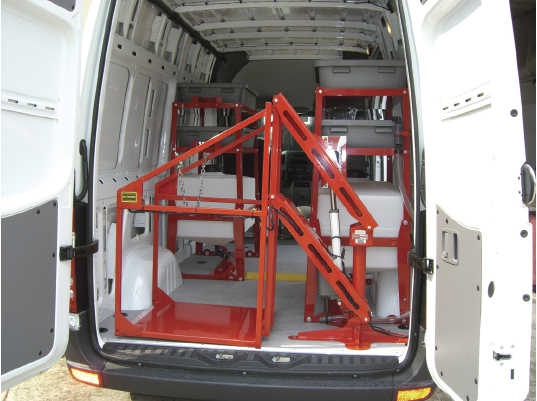
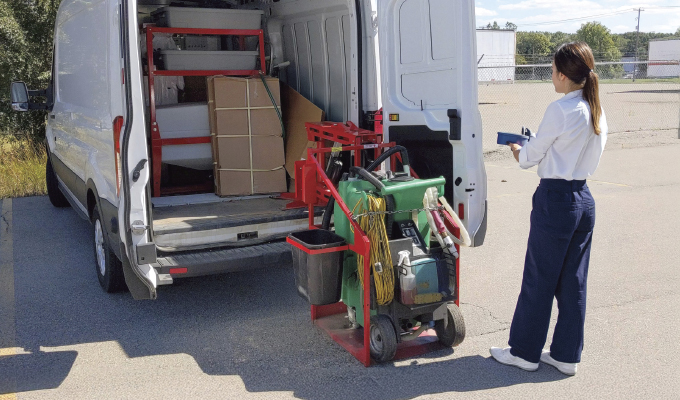
Some loads are not suited to a ramp, and that is where machine lift comes in. The CL400 mounts inside the van just ahead of the rear doors and uses a cage, closer to the gondola on a bucket truck than to anything else in a work van. The operator rolls or places the load into the cage, secures the retention chain, then presses a switch. The lift raises the load to van’s floor height and swings it into the cargo area in one motion. It handles up to 400lbs, weighs about 155lbs and runs on 12 volts through a low-maintenance electric actuator. The basket has a load space of roughly 23.5 by 29.25 inches, and it will reach a floor height of 28.75”, or 32.75” with the optional aluminum ramp kit.
Commercial cleaning fleets are the core application today. Their walk-behind floor machines run about 120lbs and rolling that weight down an incline several times a day is precisely where crews can get hurt. One customer reported their disability claims dropped by half after switching to lifts.
The second advantage is one fleets rarely consider until they are standing in the street. Deploying a ramp long enough for heavy equipment takes eight to 10 feet of clear space behind the vehicle. The lift needs about five feet, and six is a safer planning number. On a tight lot or a busy curb, that difference determines whether a crew is working in traffic.
SPECIALIZED WORK, SPECIALIZED EQUIPMENT
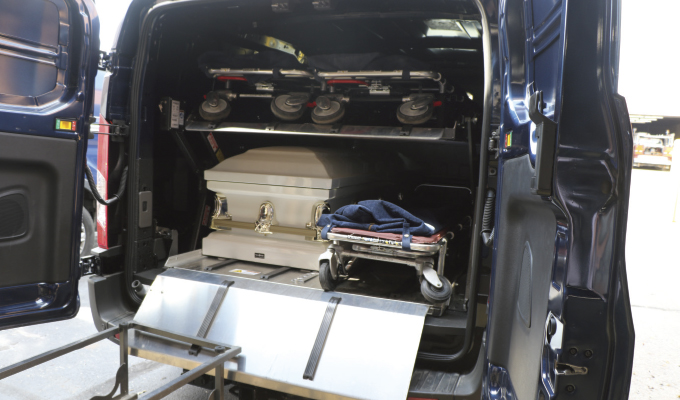
Not every loading problem belongs to a trade fleet. Medina Upfit also installs mortuary transport equipment, including the DD2000-XLC double-deck system, and the reasoning there is instructive.
Funeral providers move remains between hospitals, residences, and their facilities far more often than they run a formal service, and many do not want that work announced. A double-deck system in a cargo van lets them do it in a vehicle that looks like any other on the road. One advantage for service providers is that their vehicle is inconspicuous, the other is reducing miles on their hearse.
The electric-powered upper deck carries 600lbs and raises and lowers so a single person can load and unload, which matters in a field facing the same staffing pressure as everyone else. We have put the system on a hybrid platform as well. When a vehicle returns better than 20 mpg against 12 for a conventional commercial unit, the fuel savings are real.
INSTALLATION, SECUREMENT AND WHAT COMES AFTER
This equipment gets the load into the vehicle; however, securing it once it is inside, is a separate job, and that is done with E-track and L-track, specified to the cargo. The CL400 is a permanent bolt-in installation, and it requires drilling the floor. Hole count depends on the platform. A Mercedes-Benz Sprinter with the factory in-floor cargo track takes three, a Sprinter with a standard floor takes five, a Nissan NV takes six, and a Ford Transit or ProMaster takes seven. The unit also gets wired to the battery through an inline fuse. It ships fully assembled on a predrilled base plate, which keeps install time down.
Since it is bolted rather than welded, it can be removed and moved to another vehicle. Two cautions. Base mount kits are platform-specific, so a Sprinter kit will not serve a Transit. The floor penetrations must be properly plugged and sealed before the vehicle is remarketed. On an electric van, Link requires professional installation by a trained technician, and that requirement should be taken seriously given what runs beneath those floors.
WHAT IT MEANS FOR A FLEET
The return shows up in two places. The first is accidents, and the claims that follow them. The second is harder to put on a spreadsheet but it is just as real: hiring and keeping people. When the work involves wrestling heavy equipment in and out of a van all day, crews wear down and turnover follows. When the equipment does the lifting, that job is open to a far wider range of candidates.
For fleet managers evaluating an upfitter, the advice is simple. Find someone willing to dig into your process. Plenty of shops treat a customer as a number and build whatever was ordered. The right partner asks how many times a day you will use the equipment, where you park when you use it, how many people ride in the van and what the load weighs. Without those answers, nobody can specify the right solution, and the vehicle your crew lives in every day is not the place to guess.
about the author
Tigh Shaffer is general manager of Medina Upfit, the commercial upfitting division of the Ken Ganley Automotive Group in Medina, Ohio. The shop serves customers across roughly five states and specializes in commercial van upfits, liftgates and utility bodies. For more information, visit medinaupfit.com.