
Your work truck is your showroom, workshop, warehouse, office, call center, lunchroom, and so much more combined in a single package that must function at peak efficiency mile after mile, day after day.
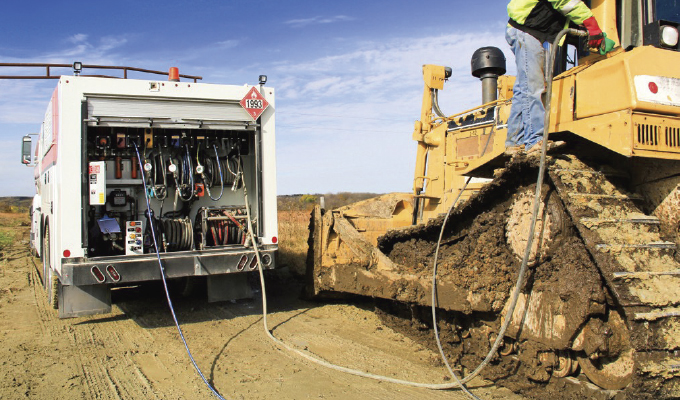
If your business includes fuel delivery, welding, fertilizer and pesticide applications, pressure washing, irrigation, septic system maintenance, or any one of a thousand other jobs that require hoses, then you know that organization is the key to staying productive, efficient, safe, and sane.
This is where reels enter the picture. Hose reels are force multipliers that help you add capacity, enhance performance, and improve profitability. However, do you know the differences between a straight-off-the-shelf, one-size-fits-all hose reel and a superior reel thoughtfully engineered with custom features that can make your life so much easier?
QUALITY COMPONENTS, QUALITY PERFORMANCE
Everything starts with a solid frame that provides the proper foundation for whatever you throw at your reel, but you also need a solution that’s relatively lightweight and easy to handle. The primary components of a reel, including the frame, drum, and discs, are typically made from three materials:
Painted steel is the durable, cost-effective choice for most general-purpose applications, such as pressure washing, hydraulic and pneumatic tools, and oxy/fuel welding.
Stainless steel provides a corrosion-resistant finish for applications regularly exposed to moisture or chemicals. It’s typically used for fertilizer and pesticide applications, fuel delivery, and other chemical/bleach applications.
Aluminum construction offers the superior, corrosion-resistant option for truck owners who are also looking to reduce the weight of the hose reel they select by up to 30 percent, depending on the size of the reel.
While the composition of the hose reel components is critical for longevity in tough conditions, manufacturers of high-performance hose reels pay attention to every detail.
For example, spring rewind reels should feature a declutching arbor that temporarily disconnects the arbor/spindle from the rewind mechanism to prevent damage to the internal drive spring when the reel is wound backward.
Many different swivel joints are available depending on the fluid you are running for your application. Fuel, pesticides and fertilizers all require special fluid paths and swivel joints, so be sure to specify this detail with your reel manufacturer.
For example, when working with highly corrosive materials like bleach, swivel joints exposed to harsh chemicals should be made from CPVC, and drums should offer a slotted hub that provides a direct path for the hose from the swivel joint, minimizing fluid contact with metal components.
CUSTOMIZED FOR THE WAY YOU WORK
You constantly think about how you can arrange your truck to make it function as a well-oiled machine, so your hose reel needs to fit into your system. High-performance reels can be configured in hundreds of different ways to fit and perform exactly the way you want.
First, you should consider how you’re using your hose. It’s obvious that larger diameter and longer length hoses require higher capacity reels, but the bend radius of your hose—how flexible or stiff it is—is also crucial for avoiding strain or damage to the hose. Oversized or undersized reels can result in improper winding, which can reduce the life of your hose and your reel.
To help remove the guesswork, leading manufacturers offer complete reel packages with factory-installed lengths of hose and hose stops for a variety of common applications, including air/water, lube/hydraulic, twin-grade welding, grease, DEF, and fuel.
Pressure and temperature are also critical considerations when selecting a hose reel. Premium-performance reels can accommodate temperatures from -40°F to 250°F and pressures up to 10,000 psi. Since operating conditions vary by application, it’s important to consider the environment, pressure, temperature, and other operating factors to ensure the reel is built with the proper components and upgrades for reliable performance.
You should also look at where the hose reel will be installed on your work truck. Manufacturers understand you’re always trying to squeeze more tools and equipment into the limited space available, so they offer compact versions of commonly used models to fit in tight compartments.
Reel manufacturers offer a wide array of rewind mechanisms. Manual options include hand-over-hand disc rewind or cranks that are direct, gear-driven, or chain-driven. Powered options have spring-driven drives or a motor using air, electric, or hydraulics.
Many time-saving accessories are also available directly from manufacturers for specific uses. Simple guide rollers can be added to streamline handling by smoothly, safely, and accurately directing the hose off and back onto the reel. Meanwhile, larger factory-installed guides eliminate wrestling with heavy hoses for LP gas and other jobs by helping to unwind and rewind away from the truck deck.
TREAT IT RIGHT, MAKE IT LAST
A custom-designed, high-performance hose reel is a significant investment, so leading suppliers help work truck owners extend the lifetimes of their reels by designing them for quick, regular maintenance and easily replaced parts.
The number one way to maximize the long-term reliability and durability of a hose reel is to consistently give it the once-over. Make sure the frame is structurally stable and anchored to your truck. Carefully inspect the reel for corrosion or abrasion, especially when the reel is exposed to harsh chemicals, inclement weather, and muddy worksites.
Next, periodically test the operation of the reel at your home base, making sure the hose unwinds from and retracts back onto the reel smoothly.
For example, bearings should be properly lubricated and replaced when worn. Chains and sprockets used on power rewind reels should work without jerking or making excessive noise, and chain guards should be replaced if damaged.
The swivel joint should always swing freely and fully from side to side, and manufacturers provide recommendations on how often they should be lubricated, as well as the type of grease that should be used. Hose reels with springs require occasional tension adjustments, and they should be replaced if they retract weakly or no longer provide tension.
Even nuts and bolts should be regularly inspected and maintained. Check to ensure everything remains tight and replace any damaged or corroded fasteners immediately.
Keep in mind that high-performance hose reels are precisely designed, custom-manufactured, and extensively tested to maximize performance and lifetime value. By ordering genuine replacement parts from the manufacturer, work truck owners can ensure they get the proper fit and function that will restore their reels to like-new performance.
To make maintenance and service even easier, leading manufacturers offer detailed, step-by-step guides for standard items, covering everything from adjusting retraction speeds and replacing bearings to changing swivel joint seals and freeing seized air motors.
WHEN PERFORMANCE MATTERS
If you see your work truck as a valuable partner that keeps your business rolling and your customers happy, the right hose reel can help you get the job done more productively, safely, and profitably.
Countless reel configurations and upgrades allow you to get a reel that’s precisely made for the way you work, so you don’t have to change your routine because you settled for an off-the-shelf unit. Plus, taking care of your high-performing hose reel with regular maintenance and genuine replacement parts will help you extend its life and pay dividends year after year.
about the author
Jennifer Wing is the marketing manager at Hannay Reels. Hannay Reels is a manufacturer of hose and cable reels for both OEM and aftermarket applications, offering thousands of standard models, along with a wide range of custom-design capabilities.