
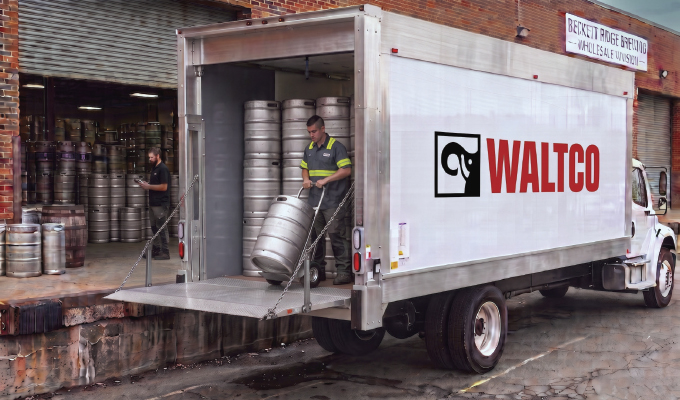
For food and beverage fleets, the liftgate is more than a piece of equipment. It is part of the daily workflow and small decisions at the back of the truck can have a surprisingly large impact on the business.
A driver can make dozens of deliveries in a day. At each one, the same basic sequence happens. Find a place to park. Navigate the customer’s environment. Get the liftgate into position. Move product. Get everything secured. Close up and move on. Then do it again.
That repetition changes the way we should think about the equipment involved. A liftgate isn’t simply there to move a pallet from the truck to the ground. It becomes part of a process that a driver relies on dozens of times a day. When that process works well, nobody really notices. When it doesn’t, the effects can show up everywhere.
THE SECONDS YOU DON’T NOTICE
Fleet managers are accustomed to looking at the big numbers: fuel, labor, maintenance, utilization, and downtime. Those are important, but there is another category of cost that can be harder to see, which is the accumulation of small inefficiencies.
A few extra seconds operating equipment. A pallet that must be repositioned because the platform isn’t quite right for the load. A control that isn’t intuitive. A liftgate that doesn’t operate consistently. None of these events is likely to trigger a report on its own. But multiply them across 30 stops, five days a week, hundreds of operating days and an entire fleet, and the picture changes.
The guide The Food & Beverage Fleet Manager’s Guide to Safer, Smarter Deliveries illustrates this with a simple example: saving 30 seconds at each stop for a driver making 30 deliveries a day can add up to approximately 75 hours per year. Across 25 trucks, that’s approximately 1,875 hours of potential productivity.
The point isn’t that every fleet can or should engineer exactly 30 seconds out of every stop. It’s that repetition magnifies everything. That is why equipment decisions deserve to be considered in the context of the entire route, not simply the specification sheet.
THE DELIVERY ENVIRONMENT HAS CHANGED
There is another reason the back of the truck deserves more attention: it is often a surprisingly complicated place.
A F&B delivery might happen behind a restaurant, in a grocery store parking lot, at a convenience store or on a busy urban street. The driver may be working around pedestrians, other vehicles, pallet jacks, forklifts, and customers, all while trying to complete the delivery efficiently.
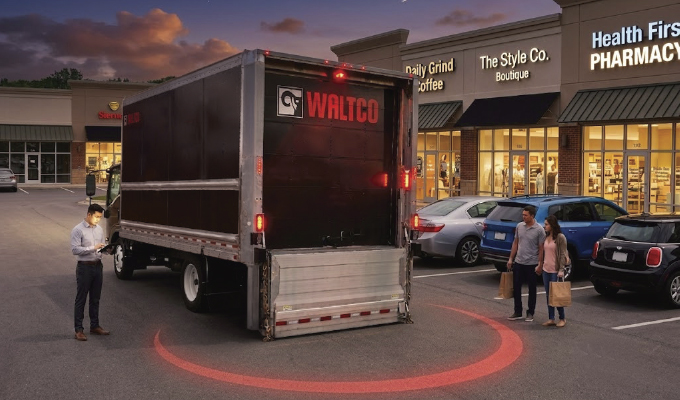
The challenge isn’t necessarily a lack of safety equipment. It’s that people around the truck don’t always know what the equipment is doing or where they should be. Audible warnings can indicate that a liftgate is operating, but they don’t necessarily define its operating area. Visual cues can provide another layer of communication.
That is the thinking behind technologies such as the Waltco ARC safety light, which projects a 180 degree visual perimeter behind the truck. The objective is straightforward: make the liftgate’s operating zone visible before the platform begins to move.
For an industry that spends so much time delivering in public and semi-public spaces, making the boundaries around the equipment easier to understand is worth considering.
DON’T FORGET WHO’S OPERATING IT
The equipment also must work for the person using it. F&B delivery is repetitive by nature. Drivers aren’t operating a liftgate once or twice a day. They may raise and lower it repeatedly while moving heavy product, maneuvering pallet jacks and working around curbs, ramps, and uneven surfaces.
That repetition has a cumulative effect. Good equipment should remove unnecessary work rather than add to it. Controls should be intuitive. Platforms should provide stable footing. The equipment should operate consistently. Those characteristics may sound like basic requirements, and they are. But basic requirements become increasingly important when an operator performs the same task dozens of times a day.
There is also a business argument here. Supporting the driver isn’t simply about making the job more comfortable. Equipment that reduces unnecessary effort and operates reliably can help drivers stay productive throughout the route.
ONE FLEET DOESN’T NECESSARILY NEED ONE LIFTGATE
Standardization is another area where the traditional approach may not always fit today’s F&B operation. Standardizing a fleet doesn’t necessarily mean putting the exact same liftgate on every truck. A better approach may be to standardize by application.
A truck handling heavy palletized loads may have different requirements from one making frequent dock deliveries. A route with tight curbside deliveries may have different priorities again. The goal is to reduce unnecessary variation while still giving each application the equipment it needs. When similar trucks perform similar work with similar equipment, drivers become more familiar with operation, maintenance becomes more predictable, and parts and training can become easier to manage. That’s a more practical definition of standardization: not one liftgate for everything, but less unnecessary complexity.
THINK BEYOND THE PURCHASE
Perhaps the biggest shift for fleet managers is to stop thinking about the liftgate as a one-time equipment purchase. The real value of the equipment is created over its working life.
How reliably does it operate? How much maintenance does it require? How easy is it for the driver to use? Does it fit the application? Can the fleet support it efficiently? What happens when something begins to wear? Those questions become particularly important in F&B, where an equipment problem doesn’t necessarily affect one delivery. It can disrupt an entire route.
Preventive maintenance is therefore part of the productivity equation. Small issues such as hydraulic leaks, electrical problems or worn components can often be identified before they become larger failures. That is also where the relationship between equipment and service becomes important. A well-maintained liftgate is more likely to deliver the consistency a fleet expects from it.
THE REAL MEASURE IS WHAT HAPPENS AT THE NEXT STOP
The best liftgate isn’t necessarily the one with the most features or the highest capacity. It is the one that makes sense for work. For F&B fleets, that means looking at the entire delivery cycle: cargo, route, operator, environment, maintenance strategy, and what happens at every stop. Since that’s where the equipment earns its keep.
about the author
Robert Mecchi is Interim President of Waltco Liftgates and vice-president of cable lifts for Hiab USA, bringing more than 20 years of leadership experience across operations, business development, strategy, and organizational growth. Throughout his career, he has led business transformations, operational improvements and growth initiatives across the transportation and equipment industries, including executive leadership roles with Galfab, Wastequip and Dennis Eagle. Robert holds an MBA from Northwestern University’s Kellogg School of Management.