
Our business runs on one simple promise: when a contractor’s machine goes down, we get it back up faster than anyone else. That commitment has defined Performance Equipment since Don Sr. Fetters, and Donnie Fetters founded the company in 1999. It started as a heavy construction equipment rental and service operation on Colorado’s Front Range, and nearly 27 years later they maintain a fleet of roughly 250 machines, including D10 dozers, 627 scrapers and excavators weighing up to 185,000 pounds, operating out of three locations along the I-25 corridor from Erie to Pueblo.
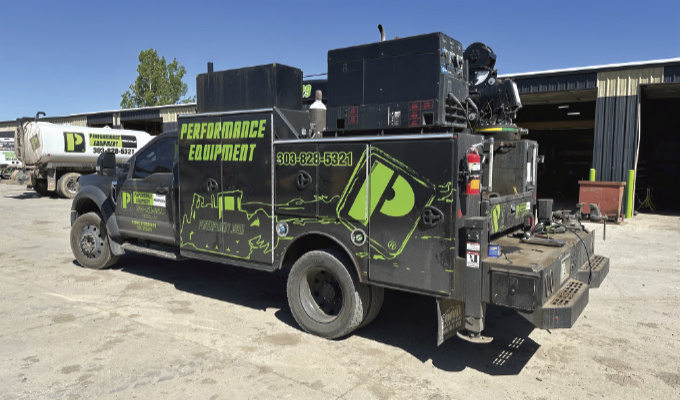
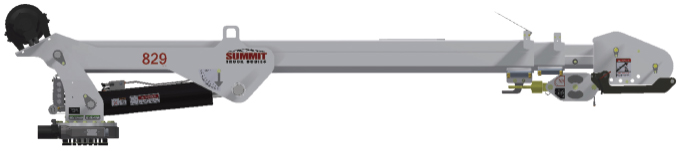
What most people see is the yellow iron with our distinctive green insignias. However, what makes the whole operation work is the fleet of nine mechanics trucks and two lube trucks. Every one of those vehicles is a mobile shop, and when one is sidelined, the ripple effect reaches every active rental in the field. That reality shaped the decision to be one of the first operators in the country running Summit Truck Bodies’ new 829 Hydraulic Crane with the ASE Phase 5 Control System.
COMPETING ON RESPONSE TIME
As an independent rental company, Performance Equipment competes against OEM dealers with deep pockets and factory-backed service networks. The way it differentiates itself is response time. When a cutting edge gets ripped off a dozer or an emissions system takes a machine down on a Friday afternoon, the mechanics are rolling within minutes. That speed depends entirely on having nimble service trucks that are ready to always go, stocked with the right tools and equipped with cranes that can handle whatever the job demands.
For years, the company ran a mix of service truck brands. Some were cookie-cutter bodies, standardized designs that come as-is with limited options. They serve a purpose, and we still have some in the fleet. However, the trucks that consistently impressed were the ones built by one specific company.
FROM USED TRUCKS TO FACTORY DIRECT
My introduction to Summit Truck Bodies came around 2015 when purchasing a used Summit body. The build quality stood out. It held up better than anything I had run, and a second used unit was bought not long after. Those trucks offered enough confidence to make a bigger commitment.
In 2023, working with Summit’s owner, and our sales representative, the company ordered their first new truck directly from Summit’s factory. Summit’s factory-direct model was a significant factor in that decision. There is no dealer layer between us and the people who engineer and build the equipment. When the service manager needs a replacement door or a drawer pack, he contacts Summit directly and gets what he needs, often overnight.
We showcased that first new Summit truck at CONEXPO 2023 and brought 25 to 30 of our team members to Las Vegas to see it. Built on an F-600 chassis with a 7,500 lbs. crane and Phase 4 control system, and with one exception, it has been in service every single day since delivery.
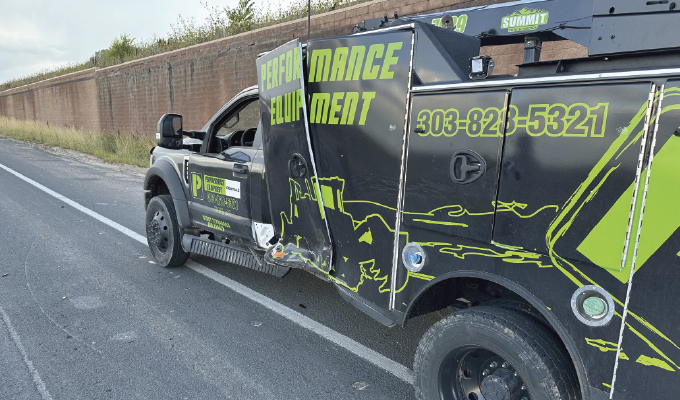
Just months after we put it on the road, a vehicle ran a stop sign at highway speed and struck the truck directly behind the cab. The photos looked like a total loss. However, Summit repaired the body and had us back in service within weeks. That experience confirmed the structural integrity of the product and the responsiveness of Summit’s support team, and it reinforced our decision to move toward a single manufacturer for our entire service truck fleet.
WHY WE WENT FIRST ON THE 829
When CONEXPO 2026 approached, we wanted another new Summit truck for our booth display. Summit had been developing the 829 Hydraulic Crane and ASE Phase 5 Control System, and Nick asked if we would be willing to put one of the first production units into daily service. I said yes without much hesitation.
Two features drove that decision. The first was weight. In 2022, we moved from an F-550 chassis to a F-600 chassis across most of our fleet, picking up 2,500 lbs. of additional gross vehicle weight. However, mechanics accumulate tools, and we were creeping back toward our limits. The 829 delivers 8,000 lbs. of lifting capacity while weighing 30 percent less than the previous 7,500 lbs. crane, translating to a meaningful increase in payload for tools, parts, and fluids.
The second was continuous 360-degree rotation. Our older cranes peaked at roughly 400 degrees before hitting a mechanical stop, requiring the operator to reverse direction. The 829 eliminates that limitation. It is not a feature that mechanics need on every pick, but it provides flexibility that adds up across dozens of service calls per week.
The crane also introduces a fully proportional control valve that allows all functions to operate simultaneously. Brad, our mechanic, who moved into the new truck from a Summit with the older 6,600-pound crane, says “the crane itself moves slower than our other cranes, but because you can boom up and extend at the same time without any jerkiness, you get the job done twice as fast.”
When you are lifting an engine from a scraper or positioning a heavy component, that smooth multi-function capability is not just about speed. It is about control.
MINUTES THAT ADD UP
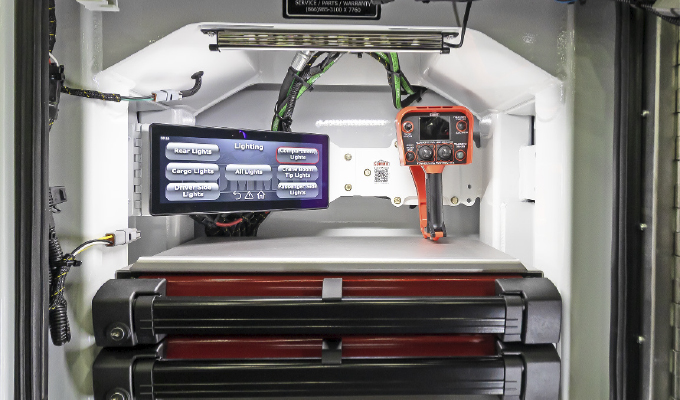
Many of our service calls last only 15 minutes. In that kind of environment, setup and teardown time matters just as much as the work itself. The auto-stow feature, operated from the wireless remote, has been another practical gain. The operator must press and hold the button during the process, maintaining control as the crane returns to its rest position. This helps prevent damage that can occur when a crane is lowered too quickly onto the body. It only saves a few minutes compared to manual stowing, but those minutes add up across a full day of four or five jobsite visits.
The outriggers follow that same theme. Their controls allow for faster, more uniform deployment and stowing, reducing setup time and helping ensure the process is the same from one operator to the next.
Our trucks are not sitting in one location. They are moving constantly, in and out of active construction sites, often on rough jobsite terrain. All are four-wheel drive, and the maneuverability of an F-600 allows us to access locations where a Class 8 service truck simply cannot go. To have 8,000 lbs. of crane capacity in that package is great.
The redesigned crane compartment is fully sealed, protecting the equipment below from water, dust, and road chemicals. That matters in Colorado, where trucks see everything from spring mud to winter road treatment. The sealed design also incorporates a double-row slewing bearing rated at 80,000 ft/lbs. It is 37.5 percent stronger than the previous standard while weighing 30 percent less.
The engineering behind that combination reflects maturity in the company’s design process that comes from listening to operators. Over time, that level of durability supports consistent uptime and more efficient operations across the fleet.
BUILT THE WAY IT’S NEEDED
Customization has been central to every truck ordered. Summit does not give you a catalog and tell you to pick from what is available. They ask how tall you want your compartments, what drawer depths your mechanics need and where you want your electrical outlets. As industry shifts from pneumatic to electric hand tools, having outlets positioned where mechanics use them, with dedicated charging stations for cordless tool batteries, is a practical advantage that shows up in daily productivity.
Summit also custom-painted the onboard air compressor and welder to match our company paint code. Equipment branding matters to us. Every piece of Performance Equipment’s fleet carries our green color, which started in 2009. Our competitors tell us it is the silliest thing they have ever seen, which means it is doing exactly what it was meant to do. They built trucks with composite liners on the interior compartment surfaces and across the full tailboard, a significant upgrade from paint that gets knocked off the first week in the field.
Mobile power equipment is another area where the right choices compound over time. The depth of available options for onboard air compressors, welders and generators continues to expand. Having a truck body manufacturer willing to integrate and customize the placement of that equipment, rather than treating it as an afterthought, is a meaningful advantage for operators who need everything to work together from day one.
SEVEN YEARS LIKE IT WAS UNDER WARRANTY
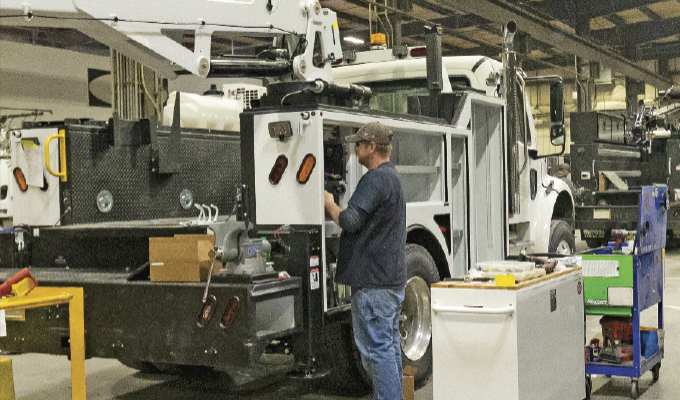
From a CFO’s perspective, the evaluation matrix for a service truck purchase is straightforward. What is needed is seven years of service that feels like the truck is still under warranty. Minimal downtime, dependable parts availability, and a manufacturer that stands behind the product.
The plan is to continue standardizing our fleet, because uniformity simplifies parts inventory, reduces training time for mechanics, and accelerates repairs. When you know that the replacement component on the shelf fits every truck in your fleet, you eliminate one more variable that can keep a service vehicle off the road.
For any fleet operator evaluating service truck purchases, the advice is simple: get what works for your fleet, not what works for someone else. Work with a company that can build exactly what you need, they know the industry and listen. When your service truck is the tool that keeps your entire rental fleet earning revenue, settling for less is a decision you cannot afford to make.
about the author
Donnie Fetters is CFO of Performance Equipment, a heavy construction equipment rental and sales company he co-founded with his father, Don Sr., in 1999. Fetters oversees financial operations and fleet acquisition strategy for the company, which specializes in large-scale earthmoving equipment including dozers, scrapers, excavators, and haul trucks.
Headquartered in Erie, Colorado, with additional locations in Colorado Springs and Pueblo, the company maintains a fleet of approximately 250 machines serving contractors across Colorado’s Front Range and throughout the western states.