
Managing a modern service truck fleet involves finding the right balance between jobsite capability and vehicle logistics. As equipment configurations evolve and service trucks become more compact, fleet managers must keep a close eye on vehicle weight. Every tool, part and piece of truck-mounted equipment must be carefully accounted for to ensure that the vehicle remains safely within its gross vehicle weight rating (GVWR).
In an environment governed by strict weight budgets and limited bed space, traditional mid-block, gasoline engine-driven welders add noticeable weight to a truck’s total payload capacity. This often requires fleet managers to be highly selective about the additional tools and parts they can carry on board. Fortunately, choosing compact, highly efficient small block engines offers a practical way forward: replacing larger, higher-displacement alternatives and allowing operators to reclaim useful weight capacity without sacrificing jobsite capability. Furthermore, because smaller-displacement engines generally require less fuel than higher-displacement alternatives, this approach delivers both payload relief and lower everyday fuel consumption.
THE PAYLOAD BALANCING ACT
For decades, mobile welding units have relied on large industrial engines to generate the necessary power for heavy equipment repair and structural field work. Since these traditional setups carry a larger and heavier footprint, they take up a noticeable portion of a truck’s available payload capacity.
When a piece of truck-mounted equipment adds extra weight to the bed, it requires fleet managers to be more strategic with their overall vehicle setup. It might mean carefully managing the volume of replacement parts carried on a given day or balancing the weight of other onboard components, like cranes or compressors. Additionally, keeping a vehicle well within its GVWR capacity helps fleet managers keep fuel consumption and routine drivetrain maintenance costs well optimized over time.
With these payload factors in mind, the objective for OEMs has been to find practical ways to trim the weight of these auxiliary systems while fully maintaining the reliable power output that professional weld operators depend on.
POWER WITHIN A SMALLER FOOTPRINT
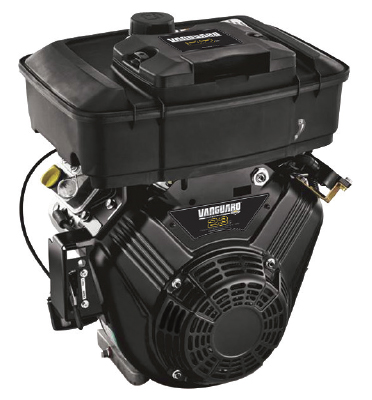
To achieve this, a practical design strategy has been to utilize compact, high-efficiency V-twin configurations. By optimizing airflow, cooling performance and engine materials, these compact power sources deliver horsepower outputs that previously required larger, higher-displacement engine blocks.
Consider the power density achievable in today’s market. Vanguard’s commercial small block V-Twin engine family, including the Vanguard 23.0 gross hp small block engine, achieves an good power-to-weight ratio. All power levels are stated horsepower per SAE J1940 as rated by Briggs & Stratton. When integrated into next-generation engine-driven welders, this compact design allows equipment manufacturers to re-engineer units to be significantly lighter and smaller than previous mid-block options.
For a fleet manager, significant weight and space savings on a single truck-mounted rig are useful gains. That weight savings translates directly into additional carrying capacity for specialized tools, rigging or more replacement components. Ultimately, it allows a service truck to operate as a more versatile mobile workshop where technicians have the right parts on hand to complete a repair on the first visit.
MAINTAINING CONSISTENT PERFORMANCE
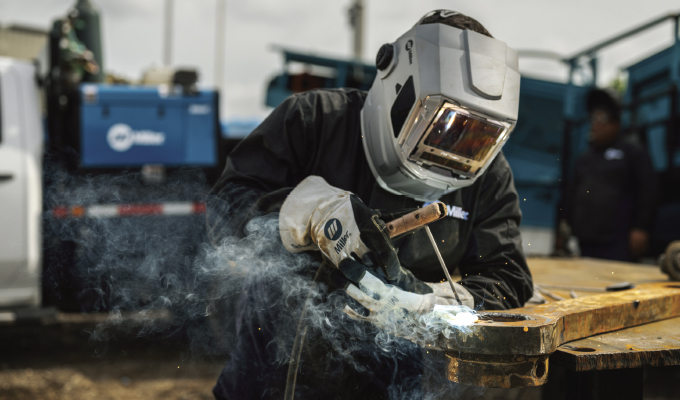
Reducing engine weight and size is only part of the goal; the equipment must still perform reliably under real-world conditions. For any mobile welding professional, a reputation is built on the quality and precision of their work. Since a strong weld depends entirely on a stable power source, power fluctuations can lead to poor weld quality and time-consuming rework.
To prevent this, compact commercial engines must be able to handle sudden, demanding electrical loads without bogging down or sagging in RPMs. This is especially true at the exact moment an operator strikes an arc. A well-designed small block engine delivers the immediate, steady power output required to maintain a stable, unwavering arc for demanding welding applications.
SUPPORTING JOBSITE PRODUCTIVITY
As mobile welding equipment continues to evolve, current equipment designs prove that work truck efficiency can be achieved alongside reliable power. By utilizing high-performance small block engines, OEMs can offer fleet operators an efficient setup: a lighter, more payload-friendly service vehicle that still provides the high-amperage output needed to handle industrial repairs.
Ultimately, selecting the right engine solution for a truck-mounted, engine-driven welder is a practical step toward maximizing payload flexibility and supporting the daily productivity of the mobile workforce.
about the author
Chris Meyers is a senior product manager for Vanguard Commercial Engines at Briggs & Stratton. With extensive experience in power application engineering, Chris focuses on developing high-performance power solutions that help OEMs and fleet operators maximize productivity and efficiency.