
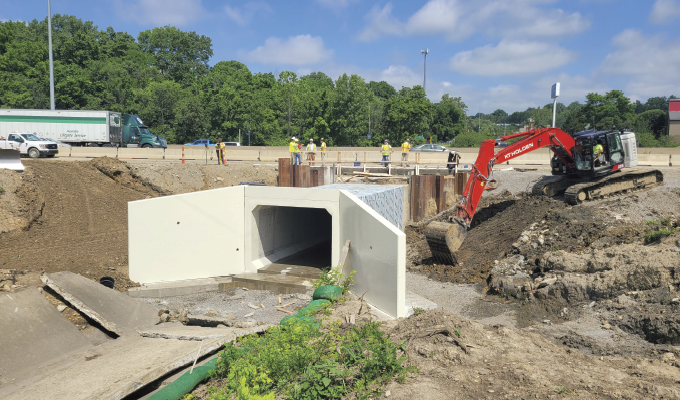
KT Holden Construction saw firsthand how important efficiency is during a major interchange reconstruction project in the Cincinnati area. The project involved rebuilding an interchange from Interstate 71 onto Kennedy Avenue, with a $5 million scope of work compressed into a limited footprint. To keep trucks, equipment, and crews coordinated and improve visibility across the jobsite, the company relied on telematics.
On dense jobsites with limited staging areas, frequent material deliveries and multiple crews working at the same time create frustrating congestion that slows down progress and complicates coordination. Trucks and equipment might be present on site but not actively contributing, while other crews wait for assets they need.
Telematics is a practical tool for work truck fleets facing these challenges. By providing real-time data on the location and status of trucks and equipment, telematics platforms help fleet managers and project leaders make informed decisions about asset allocation, staging, and movement, particularly when space is limited and schedules are narrow.
BIG SCOPE, SMALL FOOTPRINT
KT Holden Construction was awarded the reconstruction project, which was its largest public works project to date. The work involved 21,000 cubic yards of excavation, cement stabilization of the subgrade, over 12,000 feet of storm sewer, and roughly 5,000 yards of reinforced concrete pavement, along with extending a 12-foot box culvert to manage stormwater runoff. All of this had to happen within a jobsite footprint of approximately seven acres.
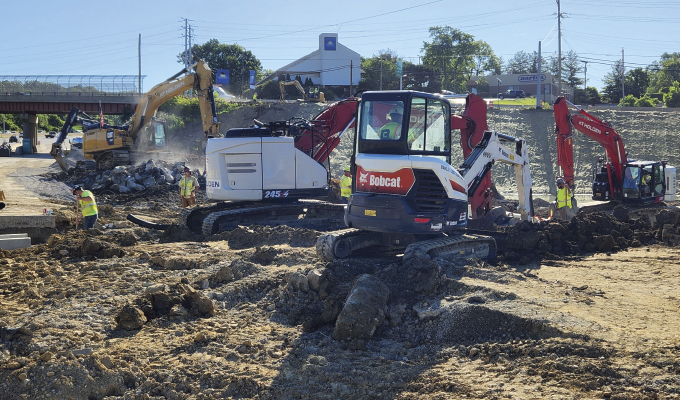
Despite the scale of the project, the physical space to execute the work was crowded. Crews operated within narrow boundaries while maintaining traffic flow, adhering to short ramp closure windows, and sequencing work carefully to keep the project on schedule. Multiple phases of construction were occurring simultaneously, with KT Holden crews working alongside electrical, concrete, and stabilization subcontractors, each bringing their own equipment and material needs to the site.
With this level of activity, the jobsite was under constant pressure. Trucks and equipment move in and out frequently. Materials had to be staged, and even small inefficiencies disrupted progress.
Gravel stockpiles had to be positioned to avoid interfering with active work zones, while remaining accessible to the crews that needed them. At times, three field crews were working at once, with one driving sheet, one moving dirt, and one installing pipe. Subcontractors came and went.
The weather made things even more complicated. Heavy rain forced changes to planning and scheduling. Two heavy rain events damaged existing channel slabs, forcing crews to revise plans and schedules. Crews pivoted quickly to redeploy resources as conditions changed. With short closure windows and no room for error, situational awareness of truck and equipment activity became even more important.
ADDING VISIBILITY WITH TELEMATICS
Project leaders used AlignOps’ FleetWatcher telematics platform to manage congestion and coordination challenges during construction. The system provided a live view of where trucks and equipment were located across the jobsite, and whether assets were actively working or sitting idle.
“It was nice to have FleetWatcher on that job particularly, so you could see different crews using equipment or not using equipment so that we could adjust if a different crew needed something,” says Tyler Holden, vice president, KT Holden Construction. “There were multiple times where one of our crews needed the dirt crew to come over and do a little bit of dirt work for them on the culvert and then go back to what they were doing. It was great being able to track that in real time.”
Data from transponders installed on the equipment flowed into the platform and was accessible from mobile devices in the field and computers in the office. This gave project leaders and supervisors a shared, up-to-date view of jobsite activity. Rather than relying solely on brief site visits or radio communication, the team could see how trucks and equipment were being used across the project and adjust as conditions changed throughout the day.
MAKING SPACE WORK HARDER
The telematics platform provided visibility which became a practical tool for managing congestion on the site. With multiple crews working simultaneously, equipment often needed to shift between tasks throughout the day. There were times when crews needed to briefly share equipment before returning to their original tasks. Those transitions had to happen efficiently to avoid delays.
By seeing which trucks and equipment were in use, and which were not, the contractor could make informed decisions about where assets were needed most. This reduced unnecessary repositioning and helped prevent equipment from occupying space without contributing to active work. On a jobsite with limited room for inefficiencies, that insight helped crews stay productive without adding congestion.
Material staging also benefited from this insight. There were only a few workable locations to store materials. Knowing where equipment was moving and when crews would need it allowed the team to stage materials more deliberately, avoiding conflicts between active work zones and storage areas.
SHIFTING EQUIPMENT BETWEEN CREWS
As work progressed, coordination between crews became increasingly important. Dirt work, pipe installation, and other activities had to remain aligned to keep the project moving forward, particularly during short closure windows.
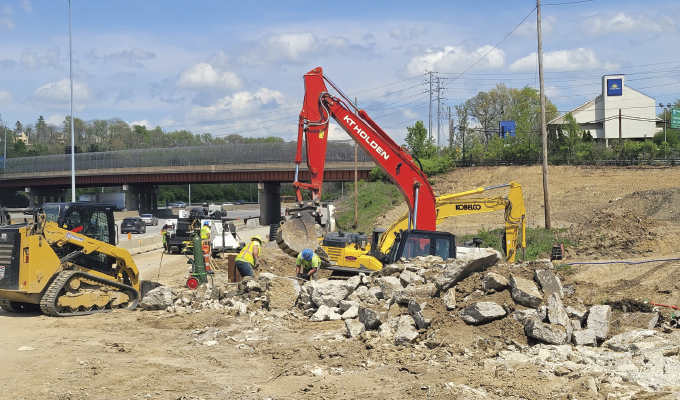
FleetWatcher allowed supervisors to see when one crew was finished with a piece of equipment and when another crew needed it. Rather than relying on assumptions or waiting for updates from the field, they could track equipment movement in real time and adjust as conditions changed.
This flexibility helped the team respond more effectively to day-to-day variations on the jobsite, including changes driven by weather or shifting priorities. Equipment could be reassigned quickly, keeping crews working and minimizing downtime in a confined space.
REDUCING IDLE
Idle equipment was another challenge that became clearer with telematics in place. While idle time might go unnoticed during brief site visits, telematics made it possible to monitor equipment status from the office throughout the day.
With better awareness of when trucks and equipment were running unproductively, the company identified equipment that was running unnecessarily and began addressing what had become a costly habit. On a crowded jobsite, reducing idle not only saved fuel and wear but also freed up space that could be used more effectively for active work.
PLANNING MAINTENANCE
Telematics also streamlined maintenance and service planning. With access to check engine alerts and service codes, the maintenance team could better prepare before heading into the field. Instead of bringing in everything “just in case,” technicians knew what tools or parts were needed ahead of time.
In some cases, the data made it clear that a service issue could wait until equipment returned to the shop. This cut unnecessary trips to the jobsite. Maintenance staff could make calls from the shop based on live data. Fewer service vehicles entering an already tight site helped reduce congestion, and kept crews focused on construction activities.
KEEPING THE JOB ON TRACK
The Kennedy Avenue interchange project required careful coordination across trucks, equipment, and crews working in a limited space. By using telematics to gain real-time insight into jobsite activity, KT Holden managed congestion, reduced idle, and kept work moving as conditions changed. For work truck fleets operating on compact jobsites, that kind of insight can make the difference between reacting to problems and staying ahead of them.
for more information
AlignOps FleetWatcher is a construction-specific fleet and materials management solution built for heavy civil and asphalt operations. The platform combines telematics, load-cycle tracking, e-ticketing, safety intelligence, and operational KPIs into one system, giving contractors real-time visibility into trucking performance, material movement, and jobsite productivity. To learn more, visit www.alignops.com/fleetwatcher, email info@FleetWatcher.com, or call (800) 553-0027.