
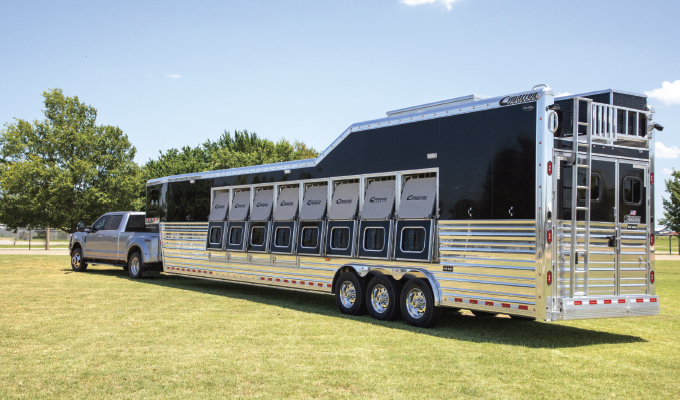
After 27 years in the trailer industry, having worked in sales and design, closely with engineering, and spending time in the warranty department; I’ve learned what fails on trailers, and how to fix it. One lesson from that work has stayed with me. When a trailer battery dies, the customer does not call the battery maker or the jack manufacturer. They often call the company whose name is on the trailer.
At Cimarron Trailers, having served as president for the past eight years, dead batteries rank among our top five service issues. That is why we are field testing the Co27 DC-DC Battery Charger from Optronics International. Our evaluation is still underway, and this is not an endorsement. However, the problem the Co27 targets affects every trailer builder, upfitter and fleet manager, and the approach deserves our industry’s attention.
WHAT RUNS ON A TRAILER BATTERY
Nearly every accessory we add to a trailer draws from a single 12-volt battery. On a typical Cimarron trailer, that battery powers the hydraulic jack, dome lights, accessory lights, and outside floodlights. Many of our trailers have air ride suspension, which relies on the battery to run its air compressor. Living-quarters trailers add hydraulic slide-outs and other 12V systems, often with two or three batteries depending on how much power the living quarters consume.
Over 70 percent of the trailers we build today have hydraulic jacks. When the battery is dead, the jack does not work, and the trailer cannot be raised or lowered. A hydraulic jack runs briefly when an operator hooks up or unhooks. Air ride is different. The compressor cycles on and off for the entire trip, whether the trailer travels 10 miles or 1,000. If the battery is not being charged along the way, it can be dead by the time the trailer reaches its destination.
LED lighting has helped because it draws far less power than incandescent lamps. However, a light left on will still drain a battery, LED or not.
WHY TRAILER BATTERIES DON’T GET CHARGED
Tow vehicles are designed to charge the trailer battery while driving. Thirty years ago, that was simple. We ran a line from the truck battery, put a fuse in it, and ran it back to the plug. As trucks have added more electronics, that charge line now passes through multiple relays and fuses. It is a far more complex system, and more can go wrong.
When a trailer battery gets low enough, it can blow the fuse on the truck. From that point, no charging occurs at all, and many customers do not know the fuse is gone until the battery is dead.
Even when everything works, the standard connection falls short. According to Optronics, the diode-and-fuse connection through the 7-pin connector causes voltage drop that prevents the trailer battery from charging beyond 50 to 60 percent capacity. A lead-acid battery that lives at that level wears out early, and cold weather makes it worse. Optronics notes that a dead flat battery will freeze at higher temperatures than a fully charged one.
THE WORKAROUNDS AND WHAT THEY COST
Operators have found ways to cope. Some customers hook a battery charger to the trailer just to get it going and others use jumper cables to get enough power to raise or lower the jack. Some add solar panels. Living-quarters trailers carry extra batteries. None of these fixes address why the battery is not being charged.
Replacing a failed battery in the field costs $250 to $300 at minimum. The larger cost is time. Most of our customers run on tight schedules, and a dead battery delays everything that follows that day. On our trailers, a dead battery does not affect the breakaway system, which runs on a separate circuit, so the impact falls on productivity rather than braking.
For work truck operators hauling a variety of different trailer types, those costs compound. One bad experience, such as a failed dump cycle, a stalled liftgate or a battery replacement that pulls an operator off the road, can easily exceed $1,000 once the battery, the service call and lost productivity are counted. Lower voltage also slows hydraulic pump motors, which can more than double dump cycle times and shorten the life of components that cost far more than a battery.
Why has the industry accepted this for so long? It is a combination of limited awareness, limited solutions and treating dead batteries as a cost of doing business. Builders see the results in service calls, even though the root cause is usually upstream of the trailer, in the tow vehicle’s charging system.
WHAT THE CO27 DOES DIFFERENTLY
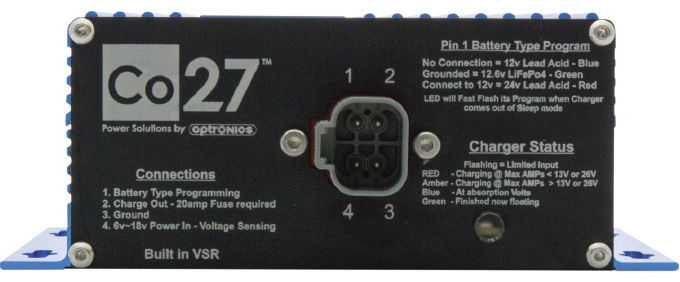
After first seeing the Co27 at the NATM convention in February and following up with Optronics afterward, in plain terms, it reads the power supplied by the tow vehicle and sends the right amount of charge to the trailer battery, without pulling so much power that it overloads the truck’s electrical system. Several features stood out.
It works with the truck the customer already owns. The Co27 installs on the trailer and connects through the existing 7-pin plug. It activates when it detects 13.2 volts or higher from the towing vehicle’s alternator, meaning the engine is running. A trailer builder has no control over what truck a customer brings to the dealer lot, so a trailer-side solution is one we can standardize.
It charges in stages. For lead-acid batteries, the Co27 uses a software-driven, three-stage cycle. Bulk charging restores a deeply depleted battery quickly. Absorption charging monitors recovery as the battery approaches capacity. Float charging maintains 100 percent state of charge. On an air ride trailer, this means the charger can replace what the compressor uses on the road instead of letting the battery slide lower with every trip.
It handles more than one battery chemistry. For lithium-iron-phosphate batteries, the Co27 delivers an optimized two-stage cycle, with chemistry selected through a wiring configuration at installation. It supports 12V towing vehicles charging 12V and 24V lead-acid and 12V lithium-iron-phosphate batteries, with specified wiring configurations for each. For builders offering living-quarters packages, one charger covering both chemistries simplifies inventory.
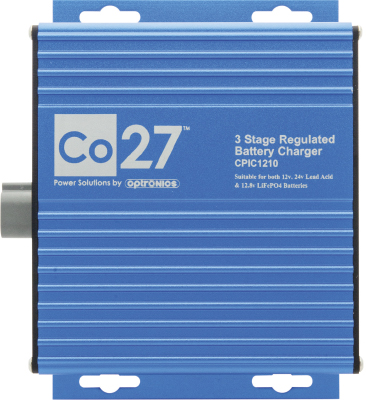
It protects the truck’s wiring. This feature speaks directly to the blown-fuse problem. When activated, the Co27 measures circuit resistance between itself and the towing vehicle’s battery. If it finds high resistance from corroded connectors, aging wiring, or undersized conductors, it reduces current draw to as low as 3.5 amps to protect upstream wiring and fuses. When conditions allow, it charges at its full 10-amp rate. A trailer may be pulled by a new truck one week and an older truck with tired wiring the next, and the charger adapts to each.
It does not drain a parked trailer. The Co27 draws zero standby current when the towing vehicle is not running. Many trailers sit for days or weeks between jobs, so a charger that adds no parasitic draw while parked matters.
It is built for the environment. The unit is housed in a sealed, anodized aluminum enclosure with stainless steel fasteners and carries an IP67 ingress protection rating. Optronics says the technology has been proven over more than 15 years in the Australian commercial vehicle market, in heat exceeding 120 degrees Fahrenheit, river crossings and heavy dust.
INSTALLATION AND INTEGRATION
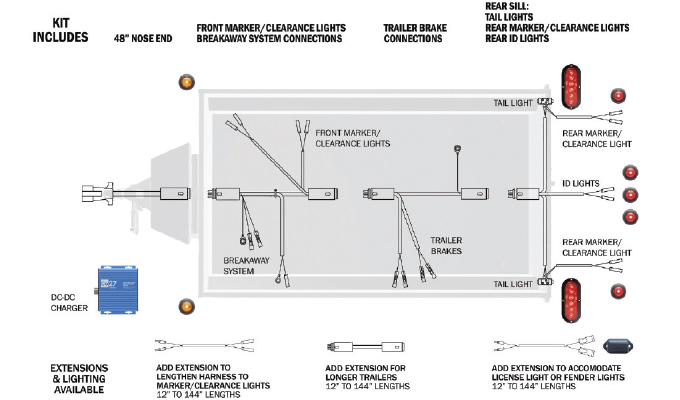
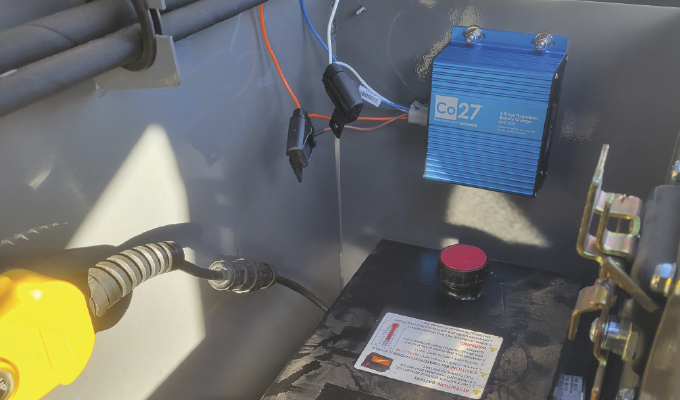
From a production standpoint, installation is straightforward. It is a couple of wires to hook up and then finding the right place to mount the unit. It is not complicated.
Optronics also offers the Co27 alongside a Dump Trailer Wiring Harness Kit from its USA Harness division, engineered with the charger in mind to minimize voltage drop. For OEMs that want the charger, harness, and lighting from one source, that system approach is worth considering.
WHAT OUR FIELD TEST WILL TELL US
We have the Co27 installed on a test trailer with a hydraulic jack, air ride and several lights, and it has been used on both short and longer trips. We will test battery charge levels for three months and six months from the start of the evaluation to see whether the battery is being maintained. Those results will tell us more than any spec sheet.
One lesson is already clear. Customers need to understand what the Co27 does. Otherwise, it is just another expense, and they will wonder what it is for. When they understand that it keeps the battery properly charged and prevents dead batteries, they will appreciate it.
For fleet managers and owner-operators dealing with repeated trailer battery failures, my advice is simple. If you’re curious about this new technology, I’d recommend doing a field test of your own. Chronic battery depletion has been accepted for a long time. It does not have to be.
about the author
Ben Janssen is president of Cimarron Trailers, a 100 percent employee-owned manufacturer of horse, livestock, cargo, and living-quarters-ready trailers based in Chickasha, Oklahoma. He has spent 27 years in the trailer industry, with experience in sales, design, and warranty, and has led Cimarron for the past eight years.