
The conversation usually begin the same way. A fleet manager or owner-operator wants an easier way to move cargo in and out of a van and want to know whether the answer is a ramp or a liftgate. My response tends to surprise people, because it don’t start with the product; it start with the work.
National Fleet Products has supplied commercial vehicle accessories since 2002, and when European-style cargo vans gained ground in North America around 2014, we added van loading and lifting solutions that had already proven themselves overseas. Today dozens of conversations take place per month with fleets, dealers and upfitters, and the ones that end well share a trait. They begin with workflow, not with a part number.
START WITH THE WORKFLOW
Before discussing equipment, three questions shape the entire recommendation.
The first is the vehicle. What van is it, and what is the roof height? A low-roof van often signals a need for parking-garage access, which can favor a longer tri-fold ramp that lowers the loading angle. The second is the operator. An owner-operator may be planning for growth, while a fleet is usually focused on standardizing equipment and protecting productivity. The third is frequency. Loading a race motorcycle once a week is a very different problem from collecting hotel laundry 20 times a day.
Answer those three, and the right solution usually starts to reveal itself.
THE FIRST FILTER: CAN IT ROLL?
The single biggest factor is whether the load can move on its own wheels, either under power or pushed by hand. Weight matters, but mobility is my first filter.
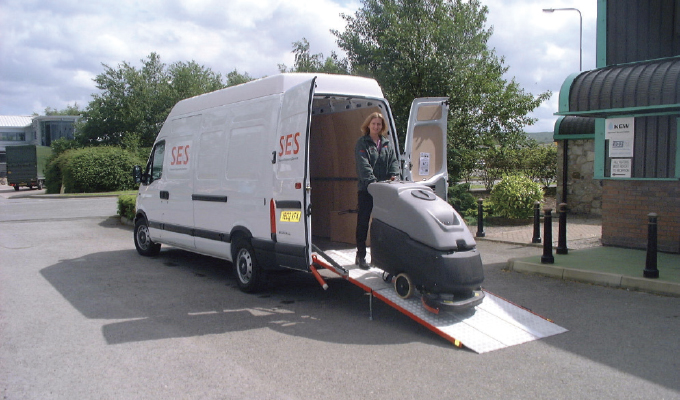
A self-propelled floor scrubber, a scissor lift or a motorcycle is a natural fit for a ramp. If the cargo is palletized, hard to control or must be lifted rather than rolled, the conversation shifts toward a liftgate. From there ask what they’re moving, and then ask for the maximum weight, not the average. Designing around the average load instead of the heaviest one is one of the most common and costly mistakes a fleet can make.
As a rule, we don’t want to sign an operator up to push or control more than about 350 pounds on a ramp and coming down is usually harder than going up. If there’s risk of losing control, and if that loss could mean an injury or damaged product, a liftgate is the safer answer.
WHEN IT’S A CLOSE CALL
The overlap sits in a middle range of roughly 350 to 1,320lbs. Below 350lbs, a ramp is usually the easy choice. Inside that band, the decision depends on how often the load moves, how many hands are available and how critical safety is for the operation.
A ramp tends to win when loading is frequent, budget is a priority and the equipment is powered or self-propelled. A liftgate tends to win when a single operator is doing the work, when safety is critical, when ramp angles would be too steep or when loads are hard to control.
Above 1,320lbs the conversation often swings back to ramps. That points to a real advantage of a deep ramp lineup. We stock ramp solutions with capacities up to 3,300lbs for self-propelled equipment, well beyond what most van liftgates can carry.
THE CASE FOR A RAMP
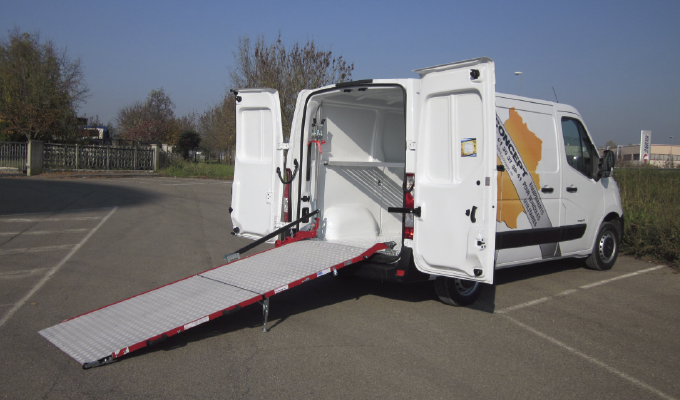
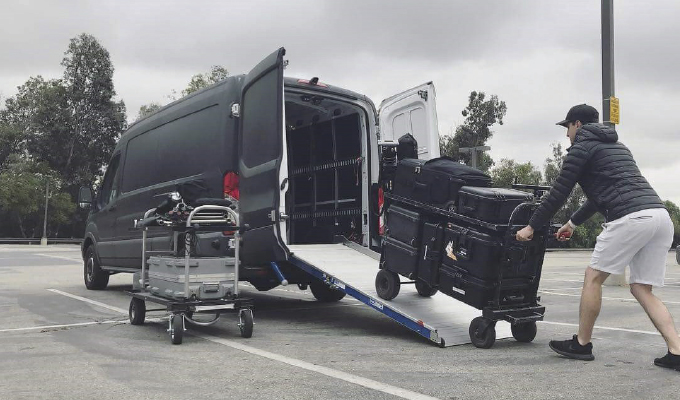
One of the most overlooked strengths of a ramp is its ability to handle equipment that exceeds the rated capacity of many van liftgates. WM System ramps reach 3,300lbs and run up to 16 feet long for very low loading angles. For more typical work, the range covers 880 to 1,500lbs across more than 50 stock configurations, which allows for matching the ramp to the job rather than force a one-size-fits-all choice.
Ramps also keep things simple. They install with no-drill hardware, carry no hydraulics and no wiring, cost less to buy, install faster and need little maintenance, which means less downtime. Models come standard with a spring assist that lets an operator ergonomically deploy and stow the ramp in seconds.
Specification is where ramps go right or wrong, and length is the dimension fleets miss most often. Many buyers are replacing short portable ramps from a hardware store that create steep angles and storage headaches. Length drives the loading angle, ease of use and ground clearance. Width should match the equipment being moved, plus a few extra inches to spare. Surface should match the environment: solid aluminum for general use, perforated for rain, snow and mud, or a shot-blasted five-bar surface for maximum traction.
Fixed ramps suit constant, dedicated loading because they’re always ready, while swivel ramps pivot aside to preserve rear-door and forklift access when the ramp isn’t in use. In many modern vans, a longer ramp delivers far better usability for a small increase in cost.
THE CASE FOR A LIFTGATE
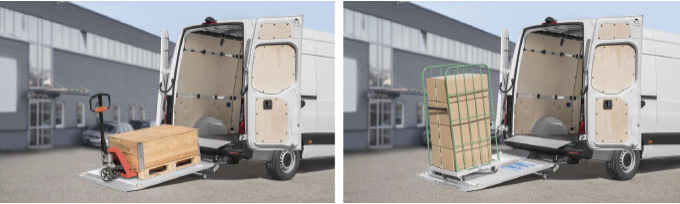
A liftgate removes gravity from the equation. That same middle range is exactly where fatigue, frustration and injuries tend to occur. A liftgate gives the operator a large, stable, level platform that raises and lowers cargo without anyone wrestling a heavy load on an incline. For a single worker moving 700lbs carts 20 or 30 times a day, often in winter conditions, it can turn a difficult task into a routine one.
The trade-offs are real. A liftgate costs more than a ramp, adds vehicle weight, takes longer to install and introduces hydraulic components that need service over time. Those costs are often outweighed when a fleet can reduce injuries, eliminate a second worker or complete more stops in a day.
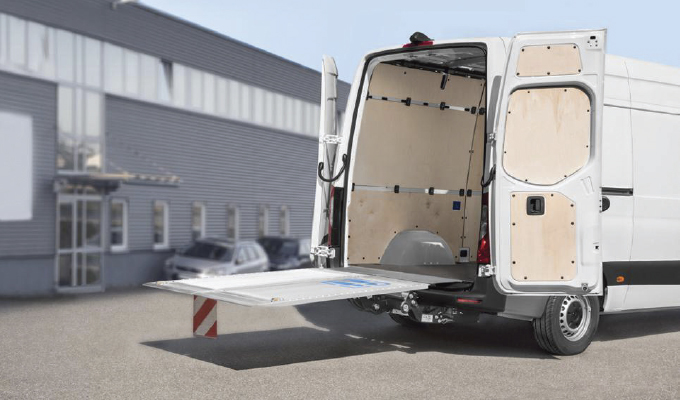
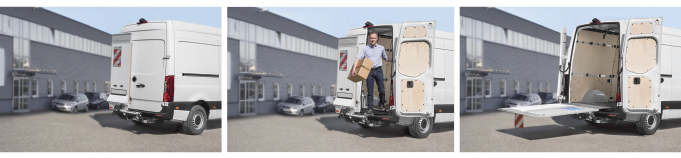
We added the Bär VanLift because we approached the van market differently, not simply because we needed a liftgate to sell. In Europe since 2006, the VanLift has accumulated real-world use across commercial applications. Its design is intended to preserve the vans value by bolting to the van’s factory mounting points, so there’s no cutting or welding and the vehicle stays in its original condition.
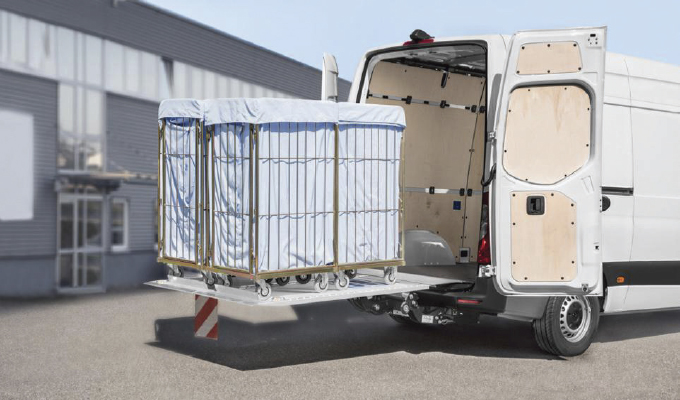
Since it mounts externally, it costs no cargo space, and in many cases, it can be transferred to another compatible vehicle at the end of the first one’s service life. Just as important, equipment that competitors often sell as options comes standard, including integrated cart stops, wireless remote operation and LED safety lighting. The folded platform leaves the right rear door accessible, and the platform is large enough to handle a pallet with a pallet jack.
WHAT IT MEANS FOR THE FLEET
The clearest payoff is usually labor. If a route currently takes two people to load and unload, the right ramp or liftgate can let one person do it safely, which in some cases effectively doubles the routes a workforce can cover. Smaller gains add up too. Save three minutes per stop across 20 stops, and a driver gains an hour for more deliveries or service calls.
There’s a workforce story underneath the productivity one. Today’s labor pool spans a wider range of ages and physical abilities than ever. Equipment that lowers physical strain lets more people do the job and do it without back and shoulder injuries. Drivers also tend to stay where the work is less punishing, so the right loading solution quietly supports hiring and retention.
The best time to make this decision is before the van is ordered. Planning the ramp or liftgate into the build lets a fleet weigh roof height, payload and chassis configuration up front, and it means the vehicle arrives ready to work on day one instead of sitting for weeks waiting on an install.
WHAT TO LOOK FOR, AND WHAT TO AVOID
A good supplier understands the application first and the product second. Fleets should weigh application expertise, product availability, installation quality, parts support, a real service network, warranty and technical depth. The true test isn’t the sale. It’s what happens after it.
The most common buying mistake is choosing on purchase price alone. The hidden costs show up later as long parts lead times, thin service support or equipment that was undersized for the work. A unit that looks cheaper up front can become the expensive option once downtime, repairs and lost productivity are counted.
A motorcycle dealership we worked with in the past makes the point. They’d already tried two ramps, a hardware-store unit never meant for commercial use and a commercial ramp too short for the low-roof van they’d chosen, which left motorcycles bottoming out at the threshold. We specified a WM System tri-fold ramp for the added length and confirmed the fit with CAD drawings before installation. They called again recently for replacement parts after nearly 10 years of service, which says something about both proper specification and durable equipment.
Getting cargo into the van is only half the job. Keeping it secure in transit is the other half, and it deserves the same attention as the loading method itself.
Advice to any fleet manager standing in the bay is simple; don’t start by choosing a ramp or a liftgate. Start by understanding the workflow. Once you know what you’re moving, how often you’re moving it and who is doing the work, the right answer tends to reveal itself.
about the author
Jacob Peterson is a sales manager at National Fleet Products, a commercial vehicle accessory distributor based in Buffalo, Minnesota. Working with a North American network of over 700 upfitters, he helps fleets, dealers and owner-operators specify loading and lifting solutions for cargo vans, including WM System loading ramps and the Bär VanLift. National Fleet Products has supplied van and truck upfit accessories across North and Central America since 2002.