
Spanning five counties in western Michigan, the Grand Rapids greater metro area has a population of over one million. This encompasses people and businesses with diverse needs, but one thing is universal, demand for on-time deliveries.
Over the past year, Optimus Group, a family commercial fleet business based in the Grand Rapids suburb of Walker, has contributed to this by providing a seamless fueling station for almost 60 propane-powered delivery trucks.
“Fleets near us have noticed and started inquiring about the benefits of our propane fleet service,” says Casen Armstrong, filling and exchange specialist, Optimus.
The fuel cost and maintenance savings, about 25 percent on both, are substantial; however, propane is also domestically produced, making the per-gallon price stable and the emissions benefits are strong, with 90 percent less nitrogen oxides (Nox).
These vehicles representing nine private fleets include bifuel Ford F59 chassis stepvans, Ford E350/E450 cutaway vans and Freightliner MT55 chassis stepvans with Prins direct-injection propane conversion systems, allowing the vehicles to operate on either propane or gasoline. There are also Ford F650/F750 commercial chassis trucks with ROUSH CleanTech dedicated direct-injection propane fuel systems.
Most of the fleet trucks that fuel up with Optimus are FedEx contractors that operate out of a facility across the road. An additional fleet operates a kitchen supply delivery business in the greater Grand Rapids area. Propane makes it convenient for drivers of these trucks to fuel in the morning before heading out on their routes, or in the evening so they are ready to go the following day.
Armstrong personally drives a propane-fueled retired police interceptor, so he fuels there, along with a Grand Rapids transit bus that now runs on propane. The company is also testing new propane engine technology related to heavy-duty diesel vehicles.
PROPANE STATION BUILT WITH EXPANSION IN MIND
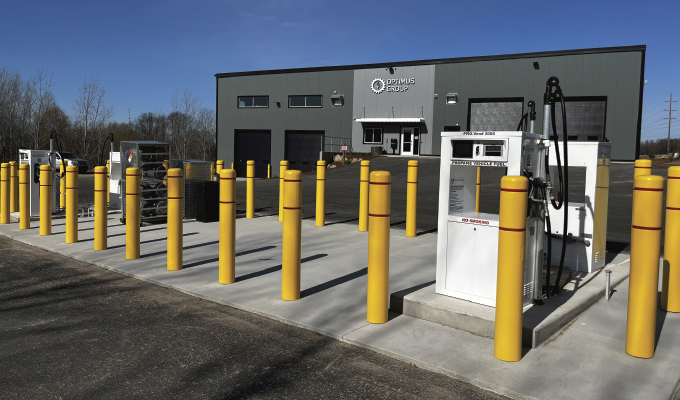
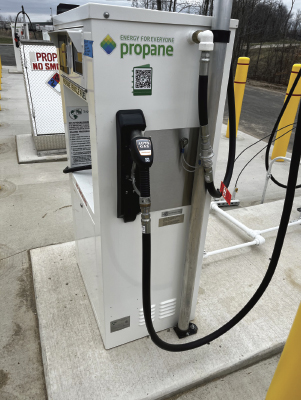
Optimus Group’s propane refueling station consists of a 30,000-gallon tank along with four PRO-Vend 2000 propane autogas dispensers from Superior Energy Systems. There is a separate dispenser hose to fill propane cylinders for applications like forklifts, since Optimus uses its own fleet to deliver those containers to a wide slate of customers. Optimus purchases propane from three local midstream suppliers.
The fueling station was intentionally built with future expansion in mind, as propane-powered fleets are growing in the Grand Rapids area due to several factors, primarily fuel price. According to ROUSH CleanTech, propane costs roughly 40 percent per gallon less than gasoline. Plus, because propane burns cleaner than gasoline, the time and cost of required maintenance like oil and filter changes are reduced. Meaning emissions are reduced in the Grand Rapids area.
An added benefit for these fleets is that propane is primarily a domestic fuel, with 90 percent of propane used in the U.S. generated here. That means it is not beholden to geopolitical issues that spike the cost of oil. In other words, propane prices are more predictable, stable and can be purchased in multi-year fuel contracts, all of which assist in budgeting for fuel costs.
Optimus began its propane journey with a single 1,000-gallon propane tank and dispenser on a skid. That evolved into the current station, with the 30,000-gallon tank and four PRO-Vend 2000 dispensers. The overall infrastructure design allows for up to six 30,000-gallon tanks to eventually be added. An added propane tank is on the horizon because it would allow Optimus additional storage during the winter, thus closely maintaining the fleet price of propane year around.
Optimus doesn’t heavily market its propane refueling infrastructure and vehicle conversion capabilities to fleets. Instead, fleets are generally approaching the company due to word-of-mouth from other fleets that have had success with propane.
“They’ve been coming to us. We aren’t against advertising, but feel very lucky we haven’t had to yet,” says Armstrong.
GATHERING, AND USING, DATA POINTS
The nine truck fleets that fuel their propane-powered vehicles at Optimus are aided by the data capabilities of the PRO-Vend 2000 dispensers. When a driver arrives at the pump to fuel, he or she uses a key fob to do so, which captures that driver’s unique identifier, the date, the time of the fill, a ticket number and potentially dozens of other data points.
“As with any new venture, we had learning curves in the first year, but this fuel management system has not been one of them,” says Armstrong.
Optimus reports out every week for each fleet what fueling activity was completed. That means each fleet’s leadership understands exactly how many gallons of fuel were pumped, at what time of day and at what price. This is important information, considering some trucks drive as far south as Holland, a 45-minute trek, and as far north as Big Rapids, an hour away. The ability to plan to refuel around where a truck will be headed on a given day is crucial.
What’s more, Optimus can furnish fleet leaders considering propane autogas with a custom spreadsheet that acts as a cost-savings calculator. Information such as how many miles per day a truck is driven is layered over the price of both propane and gasoline, so a fleet leader can easily understand how much money they will save with propane vehicles.
Drivers also benefit from the ease of fueling their propane vehicles, because the process is like gasoline and diesel, it’s important to note that as with any fuel, training is necessary. While the Propane Education and Research Council (PERC) has developed videos that walk a driver through the fueling process, Armstrong said his preference is to also conduct one-on-one training. That training takes up to 10 minutes per driver but ensures that driver understands everything necessary to have many safe and successful subsequent refuels.
FURNISHING THE TOTAL PACKAGE
There is more to Optimus Group than fueling propane work trucks and converting existing gasoline vehicles to operate on propane. Its Walker headquarters also encompasses a mechanic shop, a body shop, and a large-vehicle truck wash. All of this provides the value of convenience and reliability for its customers, most of which are located nearby but travel all over western Michigan.
Armstrong said peace of mind is what Optimus delivers to its fleet customers. From the initial propane vehicle conversion to safe and efficient refueling, the company makes it simple for fleets to reap the benefits of reduced maintenance costs, lower and stable domestic fuel costs, and reduced emissions.
about the author
Scott Dougherty is the sales engineer at Superior Energy Systems.