

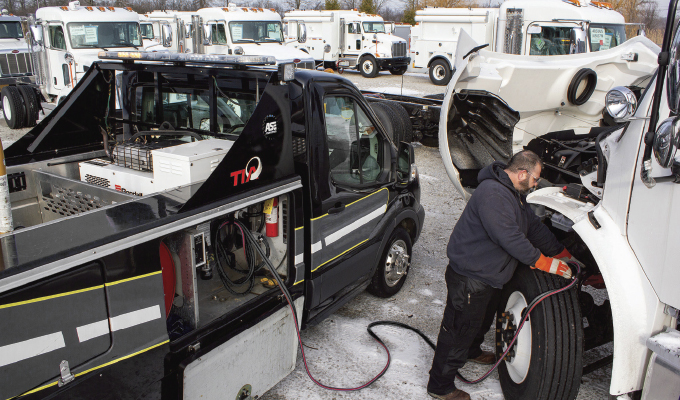
Winter has a way of exposing weaknesses in fleet operations. Equipment that performed reliably in moderate weather suddenly becomes unpredictable when the mercury drops. For work truck fleets, few problems are more disruptive than vehicles that refuse to start on a cold Monday morning.
Conventional wisdom holds that cold weather kills batteries. The reality is more nuanced. Summer heat and demanding duty cycles are what degrade battery health. High temperatures accelerate the chemical breakdown inside batteries, while heavy electrical loads from lift gates, hydraulic systems and hotel loads prevent alternators from fully replenishing charge. The batteries weaken gradually throughout the warmer months. Then winter arrives, engine fluids become more viscous, starters demand more amperage, and batteries that seemed adequate in October suddenly cannot deliver what engines require in December.
This pattern creates predictable problems for fleet managers overseeing service trucks, delivery vehicles, and utility fleets. The question is not whether you will face no-start situations this winter. The question is how prepared you are to resolve them quickly and safely.

ASSESSING YOUR STARTING NEEDS
Before investing in jump-starting equipment, fleet managers should evaluate several factors that will determine which technology makes the most sense for their operations.
Start with voltage requirements. Most light- medium- and heavy-duty vehicles use 12-volt electrical systems. Some fleets need to work with a mix of both 12- and 24-volt systems to accommodate higher-voltage off-highway equipment. Understanding this ratio helps determine whether a dedicated 12-volt solution is sufficient or whether 12/24-volt flexibility is worth the added investment.
Consider battery count and configuration. A pickup truck with a single battery presents a very different starting challenge than a Class 8 tractor with four batteries wired in series. Higher battery counts provide more amperage to overcome resistance and initiate cranking.
Evaluate your typical no-start scenarios. Are most incidents caused by operator error like lights left on overnight? Do vehicles sit idle at remote job sites where parasitic loads drain batteries over extended periods? Are you dealing with aging battery banks that struggle in cold weather but could continue serving if properly supported? Each scenario suggests different solutions.
Finally, assess your response requirements. How many vehicles might need starting assistance on any given day? How quickly must you restore them to service? Is the cost of downtime measured in inconvenience or in lost revenue measured by the hour?
TRADITIONAL VEHICLE-TO-VEHICLE BOOSTING
The simplest approach to jump-starting remains connecting a running vehicle to a disabled one with jumper cables. This method requires minimal investment, typically just quality cables with appropriate gauge wire and polarity protection.
Vehicle-to-vehicle boosting works well in non-urgent situations where a donor vehicle can be safely positioned near the disabled unit. It makes sense for occasional incidents in controlled environments like fleet yards where traffic is not a concern and vehicles can be maneuvered into proper orientation.
The limitations become apparent in field operations. Positioning two vehicles for cable access can be difficult or dangerous on busy roadways. The method ties up two assets and two operators for the duration of the procedure. It also introduces risk if personnel are unfamiliar with proper connection sequences or if they inadvertently reverse polarity.
For fleets experiencing infrequent no-start situations in low-traffic environments, vehicle-to-vehicle boosting with modern polarity-protected cables remains viable. Equipment costs are minimal, though labor costs per incident are relatively high given the time required and the need for a second vehicle.
PERMANENT-MOUNT STARTING SYSTEMS
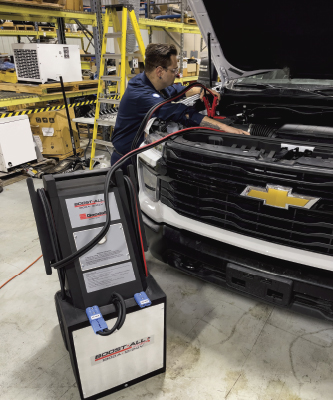
Service trucks that regularly respond to disabled equipment benefit from dedicated starting systems permanently installed on the vehicle. These systems use auxiliary batteries mounted in a weatherproof enclosure and wired to charge from the service truck’s electrical system while driving. When needed, the operator connects cables to the disabled vehicle and transfers starting power from the auxiliary bank without affecting the service truck’s own batteries.
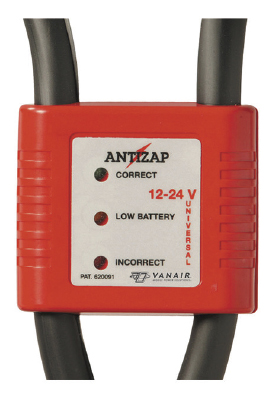
The Super Boost All system is available in two battery and four-battery configurations. These units provide 12-volt or 12/24-volt starting capability depending on model selection. The Protect All safety technology built into these systems guards against reverse polarity connections, dead shorts and accidental 12/24-volt mode selection errors.
Permanent-mount systems suit fleets with dedicated service vehicles that routinely assist other equipment. Road service operations, fleet maintenance departments, and equipment rental companies often find these systems cost-effective. The auxiliary batteries recharge automatically during normal driving, ensuring the system is ready whenever needed. Technicians appreciate not having to manage a separate portable device, and the installation keeps starting equipment secure and protected from damage.
The investment is moderate, typically ranging from several hundred to a few thousand dollars depending on configuration. Expected service life runs three to five years with proper maintenance. For fleets where the service truck’s mission includes regular roadside assistance, permanent-mount systems deliver an excellent balance of capability and convenience.
PORTABLE LITHIUM-ION JUMP PACKS
Lithium-ion battery technology has transformed portable starting equipment. Compared to traditional lead-acid battery carts, lithium-ion jump packs offer dramatically higher energy density in compact, lightweight packages. A unit weighing under 20 pounds can deliver starting power that previously required wheeled carts with multiple Group 31 batteries.
The Start All line of lithium-ion jump packs ranges from 2,500-amp units suitable for light-duty gasoline engines up through 10,000-amp models capable of cranking 16-liter diesel engines. The 12/24-volt versions address mixed fleet requirements without carrying separate equipment for different voltage systems.
Portability is the defining advantage. With their small envelopes and weighing only a few pounds, technicians can hand-carry these units to vehicles in tight quarters, on uneven terrain or in locations where wheeling a battery cart would be impractical. A single charged unit can start multiple vehicles before requiring recharging, making lithium packs efficient for morning fleet startups or multi-stop service routes.
The technology suits diverse applications. Smaller units work well for light-duty service vans and pickup trucks. Larger capacity models handle medium and heavy-duty equipment including buses, construction machinery, and agricultural equipment. Fleet managers can select from multiple capacities and price points to match specific operational requirements.
Expected service life for lithium-ion jump packs typically runs two to three years under regular use. The higher initial cost compared to lead-acid alternatives is offset by greater capability per unit, reduced labor time per start and the flexibility to address a wider range of vehicles with a single portable device.
SUPERCAPACITOR TECHNOLOGY
For operations where starting speed and volume are paramount, supercapacitor-based systems represent the most capable solution available. Unlike batteries that store energy chemically, supercapacitors store electrical charge directly. This allows them to discharge enormous current instantaneously and recharge within seconds.
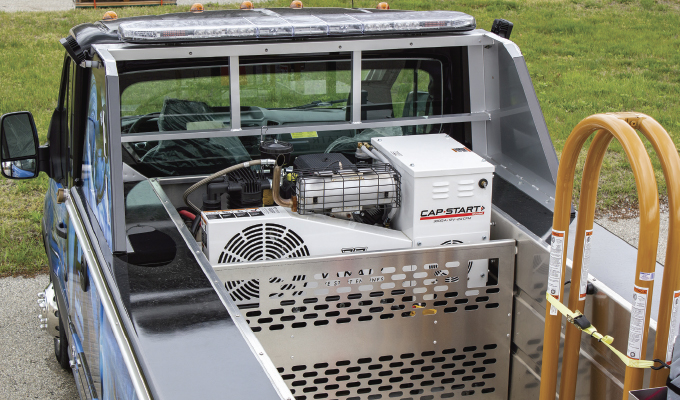
The Cap Start system harnesses this technology to deliver up to 3,000 amps of starting power. More significantly, the supercapacitor recharges rapidly so operators can start vehicle after vehicle with minimal delay between jumps. A fleet yard facing 20 or 30 disabled vehicles on a frigid morning can work through the entire lot in a fraction of the time required by battery-based systems.
Supercapacitors also operate reliably across extreme temperature ranges. The Cap Start functions from minus 40 degrees Fahrenheit to 149 degrees Fahrenheit, maintaining full performance in conditions that would compromise battery-based alternatives. For fleets operating in severe cold climates or in mixed hot and cold environments, this temperature tolerance provides operational certainty.
Four vehicle-mounted configurations are available, including a compact battery-driven version, a hydraulically driven model that integrates with service truck hydraulic systems, and versions incorporating 30-gallon air compressor capacity. All deliver the same 3,000 amps of starting power with 240 amps of rapid recharging capability.
The equipment cost is highest among the technologies discussed here. However, expected service life reaches 10 to 15 years or approximately one million charge cycles. For high-volume operations, transit agencies, mining operations, or construction fleets where equipment downtime directly impacts revenue, the total cost of ownership often favors supercapacitor technology despite the higher initial investment.
MAKING THE RIGHT CHOICE
Selecting engine starting equipment ultimately comes down to matching technology capabilities with operational realities. Fleets with occasional no-start incidents and controlled environments may find traditional methods adequate. Service operations that regularly assist disabled vehicles benefit from the convenience of permanent-mount systems.
General-purpose fleets often find portable lithium-ion packs offer the best combination of flexibility and capability. High-volume operations facing significant downtime costs should evaluate whether supercapacitor technology delivers a favorable return.
Whatever approach you choose, ensure that personnel receive proper training on connection procedures and safety protocols. Modern starting equipment incorporates sophisticated protection against common errors, but informed operators remain the best safeguard against incidents.
Winter is coming. The time to evaluate your starting capabilities is now, while the weather is still cooperative and equipment procurement does not require emergency purchasing. Your trucks cannot generate revenue sitting idle in the yard. The right starting solution keeps them moving.
about the author
Jeff Steer joined Vanair in 2017 following its acquisition of Goodall Mfg., where he had served as national sales manager since 2006. With more than 20 years in the truck equipment industry, Steer now serves as director of sales and product support for Vanair’s Engine Starting Product Group. To learn more, visit vanair.com/goodall-engine-starting-systems.