
Driver turnover is a persistent concern in the trucking industry. While competitive wages matter, the daily working environment plays a major role in whether an employee stays or leaves. Manufacturers now factor interior design and technology to address retention head-on. Fleet managers must look beyond engine specs and payloads to see how the cab environment affects performance. Seven cutting-edge cab features stand out in ensuring driver comfort improves retention.
THE RISE OF ADVANCED DRIVER COMFORT TECH IN TRUCKS
Cab comfort is a key component of safety and retention. More than transportation, the work truck serves as a mobile office where operators spend hours each day. Studies classify driver fatigue as a significant workplace safety risk and note that one in five fatal crashes are attributed to fatigue. At the same time, the National Safety Council estimated that about 17.6 percent of all fatal crashes from 2017 to 2021 involved a drowsy driver. This is the backdrop against which vocational fleets operate every day, often in dense traffic and stop-and-go duty cycles.
Advanced technology mitigates these issues by creating a supportive environment. A NewTerritory study of 1,025 commercial vehicle drivers found that 58 percent prioritized adjustable seating with posture memory, 43 percent valued ambient lighting and 41 percent preferred adaptable interiors for different work modes. Drivers signaled a strong preference for ergonomic, wellness-focused cabins over novelty features.
Put together, safety data and preference reports support what many fleet managers already suspect — driver comfort tech that lowers fatigue and mental load can improve safety, productivity, and retention in the same move.
The following cab features highlight ways fleets can turn that insight into everyday comfort and long-term driver loyalty.
1. INTEGRATED ADVANCED DRIVER-ASSISTANCE SYSTEMS (ADAS)
Modern ADAS systems, such as adaptive cruise control with stop-and-go capability, handle the tedious task of creeping through heavy traffic without constant throttle and brake input. Lane-centering assist helps keep the vehicle in the lane on crowned or grooved pavement. Blind-spot monitoring with active braking supports merges and lane changes in busy jobsites or city traffic.
According to a 2024 study reviewing the use of ADAS, most drivers reported that such technology increased their sense of safety and driving comfort. For drivers juggling navigation, radio calls, and work instructions, that reduction in constant micro decisions add up to a more relaxed day and less brain burn by the last stop.
2. SMART CAB CLIMATE AND AIR QUALITY CONTROL
Temperature regulation affects reaction time and cognitive functions. Traditional HVAC systems require constant knob-fiddling to achieve comfort. New automatic climate control technology uses sensors to detect cab temperature and sun load and then adjust the fan speed and airflow as needed. Intelligent controls that adapt in real time keep hands free for the driver to focus on the road.
Air quality also matters. Using high-flow portable air purifiers with quality cabin filters can reduce particulate counts inside vehicle cabins by as much as 50 percent and cut nitrogen dioxide levels by roughly two-thirds when adsorption filters are used.
3. ACTIVE NOISE CANCELLATION
Constant engine and road noise over a full shift contributes to fatigue, mental stress, and slower reaction times. Manufacturers now integrate active noise cancellation features in premium work trucks using microphones to monitor ambient noise and generate counter-signals to reduce noise.
Some cabs are equipped with sound-dampening panels, acoustic glass and door seals that prevent wind whistle at highway speeds. The resulting calm acoustic environment reduces fatigue and makes the cab feel more like a professional office than a machine compartment.
4. FULLY DIGITAL AND CUSTOMIZABLE COCKPITS
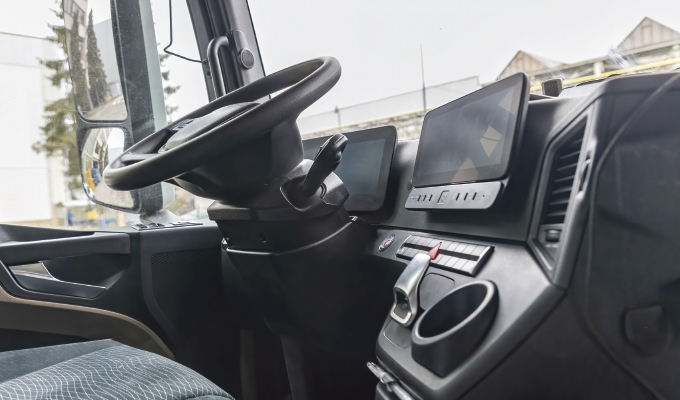
In place of analog gauges, digital instrument clusters enable fleets to show data based on the specific job at hand. A utility driver might prioritize voltage output, while a delivery driver focuses on range and navigation. Customization ensures that the driver sees what they need directly in the line of sight and without the clutter. A well-executed digital cockpit reduces eye travel and the need to mentally filter information. This reduces distraction and supports a more relaxed, confident experience through the day.
5. CAB ERGONOMICS
A 2024 study used digital human models to optimize a commercial truck cab’s design. It found that small changes, such as moving the seat rails or the steering wheel by a few centimeters significantly improved reach and comfort across drivers of different sizes. The same can be said of steering columns with wide tilt ranges and telescope adjustment.
New dashboard layouts also group frequently used controls and keep them within reach. This way, drivers do not have to lean forward or take their eyes off the road to operate accessories or lights.
6. HOLISTIC VEHICLE MONITORING FOR PEACE OF MIND
Drivers who feel uncertain about their vehicle’s condition often carry background stress that drains energy and affects how they interact with others. Integrated telematics and health monitoring helps ease that burden.
Modern predictive maintenance platforms use sensor and diagnostic data to forecast when parts require service. This translates to fewer roadside failures and less worry about where a warning light is hinting at something serious.
For example, poorly maintained tire pressure affects tire life, fuel efficiency and vehicle performance. Tire health can also swing with temperature changes. Incorporating automated pressure monitoring, brake wear sensors and fluid-level reporting into driver-visible displays turns these concerns into manageable, routine checks.
7. IN-CAB AUTOMATION OF JOBSITE FUNCTIONS
Trucks often serve as power machines for auxiliary equipment, like compressors, cranes, and dump bodies. Traditional setups required the driver to exit the cab and operate controls from outside. New technologies allow these to happen from inside climate-controlled cabs using touchscreens or joystick controls.
The benefit grows with vehicle weight and task severity. Many trucks operate up to the 80,000-pound federal limit, with specialized loads requiring precise handling. Drivers managing such loads around busy job sites need additional protection from heat, rain, or uneven ground. In addition to lowering injury risk, thoughtful in-cab automation also shortens training time. Technology that adapts across body types helps drivers move between units more confidently.
HOW PRIORITIZING DRIVER COMFORT IMPROVES RETENTION
Investing in technology signals that a fleet values its human capital. Such features transform the daily driving task from a chore into a profession. When drivers feel safe and supported, they are less likely to seek work elsewhere. Over time, that stability helps protect training budgets, service quality, and customer relationships.
about the author
Emily Newton has eight years of creating logistics and supply chain articles under her belt. She loves helping people stay informed about industry trends. Her work in Global Trade Magazine and Parcel showcases her ability to identify newsworthy stories. When Emily is not writing, she enjoys building Lego sets with her husband.