

Having spent over 25 years developing electric powertrain technology for OEMs and tier-one suppliers before founding Sigma Powertrain in 2016, I designed clutch systems, built prototype transmissions, and watched over 40 million units go into production at one of the world’s largest automakers. I also watched the commercial vehicle industry take a well-intentioned but incomplete approach to electrification.
The problem is straightforward. When most OEMs and upfitters electrify a work truck today, they pair an oversized electric motor with a single-speed gear reduction. It works. The truck moves. However, that approach forces fleet operators to accept trade-offs that would never be tolerated in a diesel-powered vehicle; compromised gradeability, limited range, excessive component costs and motors that spend most of their duty cycle operating outside their peak efficiency window.
Sigma was founded because there was a better way. Not a theoretical one, but a proven engineering approach grounded in the same principles that make conventional transmissions indispensable in internal combustion vehicles. The question asked was simple, if we would never bolt a diesel engine to a single fixed gear and send a loaded utility truck up a six percent grade, why are we doing exactly that with an electric motor?
THE CASE FOR MULTIPLE RATIOS
An electric motor produces maximum torque even at low speeds. That characteristic has led many in the industry to conclude that electric vehicles do not need a transmission. For a passenger car on flat highway, that logic holds up reasonably well. For a Class 6 utility truck carrying 10,000 pounds of tools and materials across varied terrain, it falls apart.
A single-speed BEV drivetrain requires a motor large enough to handle the worst-case scenario: maximum load on maximum grade at the lowest speed. That means the motor is dramatically oversized for the other 90 percent of the vehicle’s operating profile. An oversized motor is heavier, more expensive, and less efficient when it is loafing along at a fraction of its rated capacity. It also demands a larger inverter and, in many cases, a bigger battery pack to compensate for the energy being wasted as heat.
A multi-speed transmission solves this by allowing the motor to operate near its sweet spot across a wide range of vehicle speeds and load conditions. Instead of specifying a 1,200kw motor to cover every scenario, a fleet can pair a smaller, lighter motor with a three- or five-speed transmission and achieve equal or better performance. One of our customers did exactly that, replacing a 1,200kw motor with an 800kw unit paired with a Sigma transmission. The result was better acceleration, better gradeability, better efficiency and a smaller, lighter package that costs less to build.
The efficiency gains are real and measurable. Testing shows that a multi-speed electric transmission delivers 10 to 15 percent improvement in overall drivetrain efficiency compared to an equivalent single-speed setup. In practical terms, this means more miles per kilowatt-hour, which translates directly to extended range or the ability to specify a smaller battery pack for the same range. Either way, the fleet wins.
WHAT MAKES THESE TRANSMISSIONS DIFFERENT
Sigma’s transmissions are not adapted from conventional gearboxes. They are purpose-designed for EV applications from the ground up. That distinction matters because the operating environment is fundamentally different.
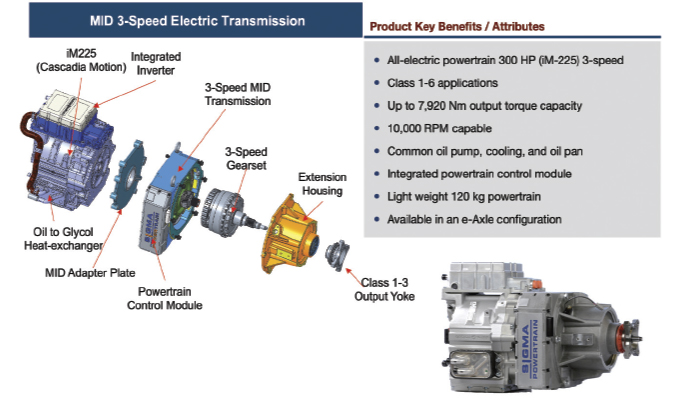
The core of the technology is a patented all-electric clutch actuation system. Traditional transmissions rely on hydraulic systems to engage and disengage clutches. Hydraulics add weight, complexity, parasitic losses, and a long list of maintenance items including seals, pumps, filters, and fluid changes. Sigma clutches are actuated entirely by electric signals. There are no hydraulic components.
The clutch plates themselves are hardened steel, heat-treated to Rockwell 55-60 hardness. They are designed as zero-wear components. There are no friction materials to degrade over time, no clutch packs to replace and no adjustment intervals to schedule. We have adapted and refined it specifically for the torque profiles and duty cycles of electric commercial vehicles.
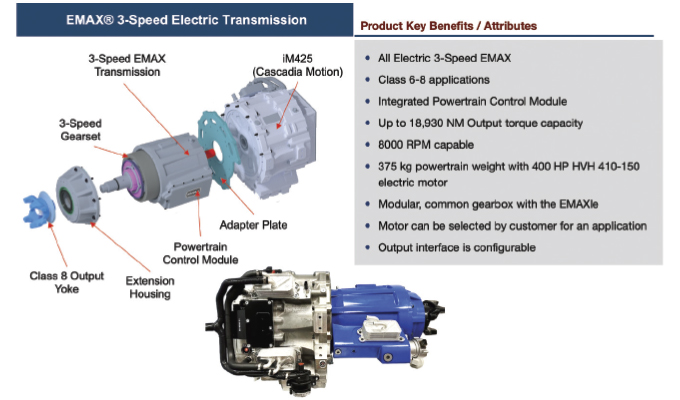
The transmissions are also motor agnostic. They are designed to integrate with electric motors from any manufacturer, which gives fleet managers and vehicle builders the freedom to select the motor that best fits their application without being locked into a proprietary system. This flexibility extends to vehicle architecture. Sigma powertrains use a central drive configuration rather than an e-axle approach, which simplifies integration with existing chassis designs and makes it easier for upfitters and OEMs to adopt the technology without re-engineering an entire vehicle platform.
PRODUCTS MATCHED TO VOCATIONAL APPLICATIONS
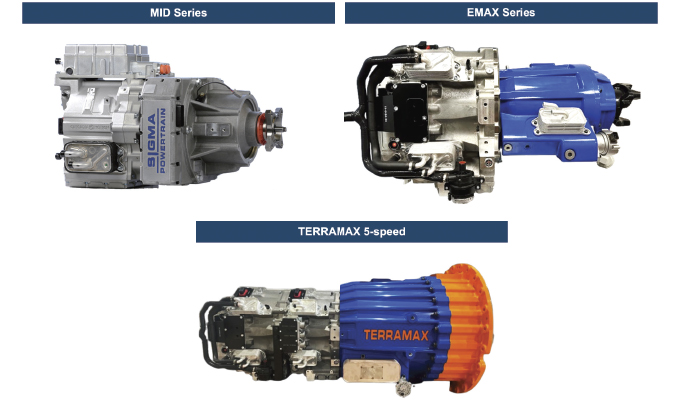
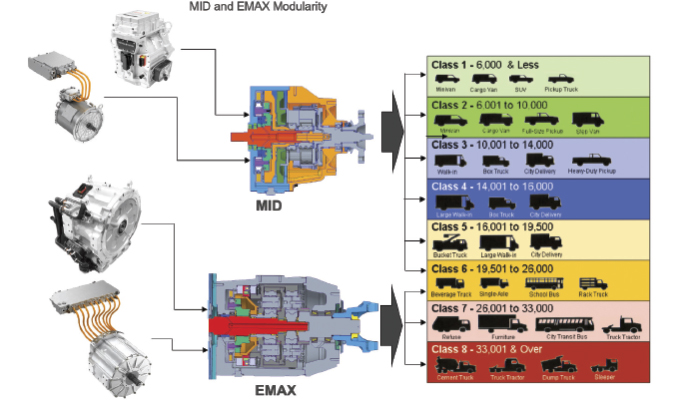
The MID-Series is a three-speed transmission rated for Class 1 through 7 vehicles, with output torque up to 7,920 Nm. This platform targets the utility trucks, service bodies, delivery vehicles, and light equipment carriers that make up the backbone of many work truck fleets. For a fleet operating bucket trucks or service vans in mixed urban and suburban environments, the MID-Series allows a smaller motor to deliver the low-speed torque needed for steep residential streets while maintaining efficient highway cruise between job sites.
The EMAX is a heavy-duty platform, available in three- and five-speed configurations for Class 6 through 8 applications. The five-speed produces up to 68,640 Nm of output torque. This is the transmission built for concrete mixers, heavy utility trucks, dump trucks, and other vocational vehicles where high sustained torque and steep grade capability are non-negotiable. The EMAX also features a hill hold function that uses a four-position clutch logic to lock the drivetrain mechanically on a grade without relying on service brakes or drawing power from the battery. For operators working on inclines throughout the day, that feature represents a meaningful improvement in both safety and energy consumption.
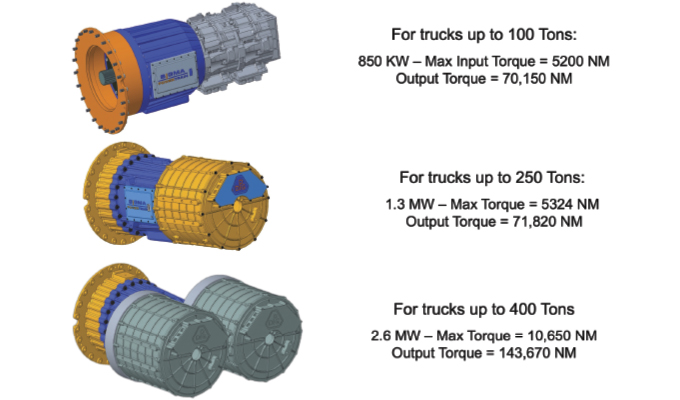
For fleets that also manage heavy equipment, TERRAMAX five-speed addresses mega-class machines such as haul trucks and large drilling rigs. With configurations scaling from 850 kW for 100-ton machines up to 2.6 MW for 400-ton platforms, it brings the same multi-speed efficiency advantages to the largest battery-electric equipment in service today.
When a customer takes delivery of a Sigma powertrain, engineers deploy with the unit for four to six weeks of on-site calibration and integration support. The transmission’s efficiency-seeking software is tuned to the specific vehicle, load profile, and operating environment. The system uses pre-conditioned lookup tables to optimize shift points and motor speed in real time, ensuring the drivetrain finds the most efficient operating point under every condition.
The warranty is 500,000 miles on the MID-Series and one million miles on the EMAX.
A PRACTICAL PATH FORWARD
Many fleet managers are still evaluating BEVs, running pilot programs and working through the realities of charging infrastructure. That is exactly the right approach, and it is one we support.
Sigma is also developing a power split hybrid architecture that will allow a vehicle to operate as a hybrid today and convert to a full BEV when a fleet is ready to make that transition. The technology reflects the broader philosophy of meeting fleets where they are and gives them a clear, practical path to full electrification.
For fleets that are already operating battery-electric work trucks or are preparing to spec their next BEV purchase, take a hard look at the powertrain. Ask your OEM or upfitter what type of transmission is in the vehicle. Ask whether the motor is sized for peak demand or optimized for the full duty cycle. Ask about parasitic losses, grade performance, and real-world range under load.
The commercial vehicle industry solved these questions decades ago with internal combustion engines. We matched engines to transmissions with the right number of gears, the right ratios, and the right shift logic to keep the engine in its power band. Physics have not changed just because the power source is electric. If anything, the case for a properly matched powertrain is stronger, because every kilowatt-hour you waste is a kilowatt-hour you must put back in from the grid.
The technology exists today to build battery-electric work trucks that perform as well as their diesel counterparts, cost less to operate and go farther on a charge. It starts with the powertrain.
about the author
John Kimes is CEO and president of Sigma Powertrain, which he founded in 2016. He brings over 25 years of experience in electric powertrain design and development, with a career rooted in OEM and tier-one supplier engineering. Kimes is the inventor of multiple patented technologies including all-electric clutch actuation systems, and his work has contributed to powertrain components found in over 40 million production vehicles. Prior to launching Sigma, he held engineering and consulting roles focused on advanced drivetrain systems for major automotive manufacturers. Today he leads a team that holds more than 50 patents and is focused on delivering purpose-designed multi-speed electric transmissions for commercial, vocational, and off-highway vehicles.