

If you operate dump trailers, liftgate trucks, gooseneck trailers with powered landing legs, or any commercial trailer that relies on a battery to run hydraulic equipment, you know the frustration of batteries dying too soon. They fail at the worst possible moment. Replacing them has become so routine that most fleet managers budget for it like tires, as an inevitable expense rather than a solvable problem.
However, it is solvable, and the solution has been proven for over 15 years in one of the most demanding commercial vehicle markets on earth.
Before becoming president and CEO of Optronics International last year, my career took me to Australia building and running companies that design electrical systems for commercial vehicles. Australia is not a forgiving environment for anything with wheels and wiring. Trucks routinely operate in temperatures above 120 degrees Fahrenheit, cross rivers, traverse hundreds of miles of unpaved roads choked with dust and then sit idle in remote yards for days between jobs.
If an electrical product can survive that, it can survive anything. That environment became the proving ground, and the technology that emerged from it is the Optronics Co27 DC-DC battery charger.
THE PROBLEM NO ONE TALKS ABOUT
Walk the floor at any work truck trade show and you will find hundreds of innovations designed to make fleets more productive. Better hydraulics. Smarter telematics. Lighter materials. However, nobody talks about what happens between the towing vehicle and the trailer battery, and that silence is expensive.
Here is what happens. When you connect a trailer to a towing vehicle through a standard seven-pin connector, the trailer battery is supposed to receive a charge from the truck’s alternator while you drive. In practice, it rarely works that way. The diode-and-fuse connection creates a voltage drop that prevents the trailer battery from ever reaching full charge.
Under normal towing conditions, the battery typically sits at 50 to 60 percent capacity. For a lead-acid battery, that is not half full. It is the beginning of the end. A chronically undercharged lead-acid battery sulfates, meaning crystals build up on the plates and permanently reduce the battery’s ability to hold a charge. Every cycle at partial capacity shortens its life. In cold weather, the problem accelerates. A fully charged lead-acid battery will not freeze until temperatures drop well below zero. However, a battery at 50 percent state of charge can freeze at single-digit temperatures, a reality that fleet operators in northern climates know well.
The industry’s response, for decades, has been to accept this as normal. Operators plug trailers into mains chargers overnight, run heavy-gauge welding cable directly from the truck battery, add second batteries or simply replace batteries every few months. These are workarounds, not solutions, and they all add cost without addressing the root cause.
CHARGING THAT ADAPTS TO REAL-WORLD CONDITIONS
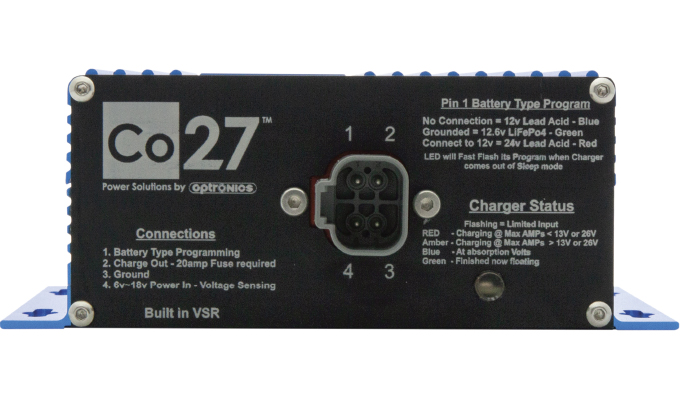
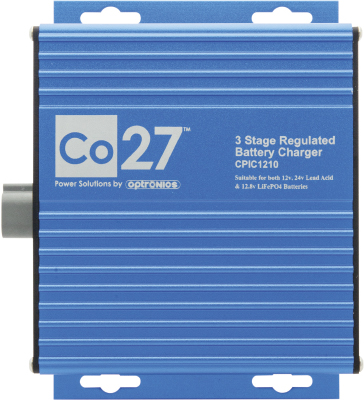
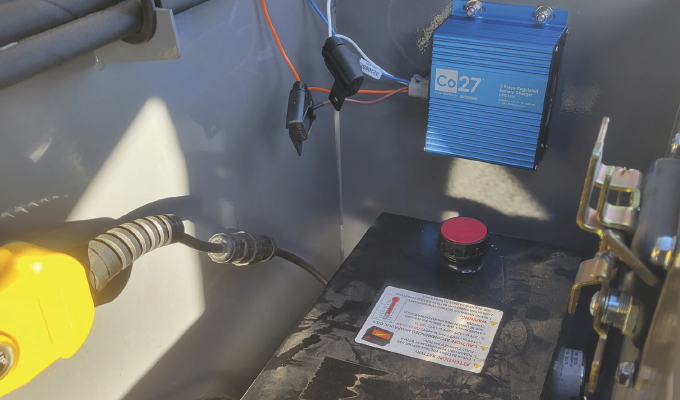
The Co27 was designed to eliminate every one of those compromises. It installs in the trailer and connects through the existing seven-pin plug, requiring no modifications to the towing vehicle. When the truck’s engine is running and the alternator produces 13.2 volts or higher, the Co27 activates and begins a software-driven, three-stage charging process tailored to the battery’s actual condition.
In the bulk stage, when the battery is deeply depleted, the charger delivers energy at its maximum rate to restore capacity quickly. As the battery approaches full charge, the Co27 shifts to absorption mode, slowing the charge rate and monitoring recovery to prevent overcharging. Once the battery reaches 100 percent, it enters float mode, maintaining full state of charge for as long as the vehicle is running. For fleets using lithium-iron-phosphate batteries, the Co27 delivers an optimized two-stage cycle. Chemistry selection is handled through a wiring configuration at installation, so trailer manufacturers and fleet maintenance teams can support both lead-acid and lithium systems with the same unit.
Every trailer wiring system is different. Some have clean connections. Others have years of corrosion, undersized conductors, or damaged pins. When the Co27 activates, it measures electrical resistance across the entire circuit between itself and the towing vehicle’s battery. If it detects high resistance, it reduces current draw to as low as 3.5 amps to protect upstream wiring and fuses. When the circuit allows, it charges at its full 10-amp rate. This means it works safely on older trucks with marginal wiring just as well as it does on new equipment, extracting the maximum possible charging current from whatever circuit exists.
There is another feature that matters more than it might appear on paper: the drawing of zero standby current. When the towing vehicle is not running, the charger places no load on the trailer battery. Many supplementary battery devices draw small amounts of current even when idle. Over days or weeks between jobs, that parasitic draw compounds, especially in cold weather. Zero standby current means a trailer that was fully charged when parked will not be depleted when the operator returns.
WHAT UNDERCHARGED BATTERIES ACTUALLY COST A FLEET
The price of a replacement battery is the most visible expense, but it is far from the most significant. A Group 27 deep-cycle battery runs $150 to $250. Add a mobile service call to replace it in the field and you are easily at $400 to $500. Factor in downtime, an operator who cannot complete a dump cycle and a tendered load that does not get delivered, and a single battery failure can cost over $1,000.
There are also costs that rarely appear on a maintenance report. An undercharged battery delivers lower voltage to the hydraulic pump motor, causing slower dump cycles. An operation that should take 30 seconds can stretch to over a minute. Multiply that across dozens of cycles per day, across a fleet of 50 or 100 trailers. The reduced voltage also forces the pump motor to work harder, generating excess heat and wear, shortening the lifespan of components that cost far more than a battery.
In the Australian fleets where the technology was first deployed, operators reported dramatic reductions in battery replacements and measurable improvements in hydraulic equipment longevity. Those results are now available to U.S. fleets.
A SUSTAINABILITY STORY THAT ALSO MAKES FINANCIAL SENSE
The commercial trailer industry generates a substantial volume of prematurely discarded lead-acid batteries every year. Each contains roughly 20 pounds of lead and a quantity of sulfuric acid. While the U.S. achieves a high recycling rate for lead-acid batteries, reducing unnecessary waste at the source is more effective than relying on end-of-life recovery. Every battery that reaches its full intended lifespan is one less battery manufactured, shipped, installed, and recycled. For fleets tracking sustainability metrics or reporting under ESG frameworks, the Co27 provides a measurable reduction in battery waste requiring no operational changes, no new infrastructure, and no training.
about the author
Mathew Jenkins is president and CEO of Optronics International I USA Harness International, headquartered in Tulsa, Oklahoma. He is a veteran of the commercial vehicle electrical systems industry with deep expertise in harness design, power management, and trailer electronics. Prior to joining Optronics, Jenkins founded and led multiple technology companies in Australia serving the commercial vehicle sector. Find out more about Optronics’ Co27 DC-DC battery charger, visit www.optronicsinc.com.