
The perfect fit for an operation can boost efficiency, improve safety and drive profitability. Gross vehicle weight ratings (GVWRs) indicate what the drivers handle and how well managers right-size their vehicles to align with corporate goals.
However, with a fine line separating the options in Class 3 versus Class 4 truck GVWR comparison, making the smartest investment requires careful consideration. This work truck payload capacity guide breaks down the essential factors that will help managers select a truck that works as hard as their team.
BRAKING MECHANISMS
Quality brakes are some of the most crucial elements of a truck’s safety. As a truck’s GVWR increases, so does the demand placed on its braking system to handle the additional thousands of pounds. While many Class 3 and Class 4 trucks use similar hydraulic braking systems, trucks built for heavier loads—often those in the higher end of the Class 4 range—may feature more advanced braking technology. In these heavier vehicles, drivers might find hydraulic systems with electric assist or even full air brakes. Generally, as the GVWR increases, components like rotors and calipers are also made more heavy-duty to better disperse heat and handle intense strain.
This progression is important for safety. A truck operating at the upper limit of its GVWR will require a longer stopping distance than a more capable truck carrying the same load. A system designed for heavier weights is better equipped to handle sharp declines and is less susceptible to brake fade. These differences can affect everything from driver safety to operating costs and inspection intervals.
Additionally, braking systems can affect other truck operations. For example, if the vehicle has a hydraulic hybrid system, it could feature regenerative braking to get 60 to 70 percent more miles per gallon and reduce carbon emissions.
GVWR
When reviewing Class 3 vs. Class 4 truck’s GVWR, most people consider the engine first. However, the GVWR is more significant and comprehensive of the truck’s abilities. It represents the vehicle’s total mechanical limits and weight, including the chassis, body, fuel, passengers and cargo.
- Class 3: 10,001 to 14,000 pounds GVWR
- Class 4: 14,001 to 16,000 pounds GVWR
A practical case study comes from the experts at Reading Truck, who emphasize the importance of calculating payload capacity. They define it simply, GVWR minus curb weight, or the weight of the truck when empty.
Consider this advice in the context of a small holder farm. It might invest in a 14,000lbs GVWR truck, which might seem sufficient. This truck could carry its crew, some bags of fertilizer and a few landscaping tools. However, if the team needs to haul heavy stone pallets, larger mowing equipment or full water jugs, it will likely exceed the truck’s payload capacity. Pushing a vehicle beyond its GVWR can lead to degradation and downtime for repairs to parts like tires, suspension and the frame itself.
The higher class can accommodate heavier equipment, and the buffer provides peace of mind. However, as Reading Truck’s calculation method implies, choosing a higher class by default can be inefficient. If the workforce has little to carry, the truck’s potential is wasted, leading to higher fuel consumption for less weight and a delayed return on investment.
UPFIT CAPACITY
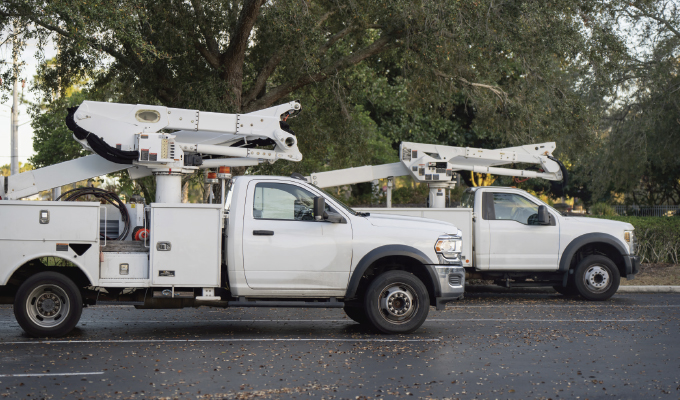
A truck’s upfit capacity—its ability to handle specialized equipment—is directly related to its GVWR. While a Class 3 chassis is suitable for standard upfits such as plows or utility beds, a higher GVWR is required for more demanding additions. For instance, a plumbing contractor would require a Class 4 truck with its stronger frame and suspension to support the significant weight of water tanks and pumping equipment. Choosing the right class ensures the truck can be safely customized for specific tasks without exceeding its weight limits.
The collaboration between Adrian and ADT offers a real-world example. When ADT transitioned its fleet to the Ford Maverick, a compact pickup, it faced an upfitting challenge. There was no existing solution to accommodate the specialized tools, ladders, and sensitive electronic equipment that its technicians carry.
Instead of just adding shelves, Adrian’s team studied the technicians’ daily workflow, analyzing how they carried tools, which equipment was needed for each job, and how often they visited the warehouse. This understanding of the job led to a meticulously crafted upfit with custom storage for everything from tiny sensors to multiple ladders of varying sizes.
This case illustrates that true upfit capacity is about the vehicle’s potential to be customized for specific, real-world tasks. A higher upfit capacity allows for more specialized and efficient configurations, ensuring teams can carry everything they need without compromising safety or organization.
REGULATORY COMPLIANCE
As teams choose higher-class vehicles, the trucks become more advanced and require more oversight. Every class introduces new regulatory requirements that become increasingly stringent to ensure safety.
This means a Class 4 will demand more attention than a Class 3, though it is equally vital to know the legal and safety requirements for each. Often, they are subject to guidelines issued by the Federal Motor Carrier Safety Regulations and the Department of Transportation. Individual states may also have more specific requirements, so drivers must review their local requirements before purchasing.
The experts at TCS Fuel provide an example of the real-world implications of these regulations. They remind drivers that compliance is a constant factor on the road, not just an annual safety audit.
At any weigh station, inspectors can review a host of items, including:
- Gross vehicle weight.
- Axle weight.
- Driver logbooks.
- Safety and compliance status.
- Commercial driver’s licenses and other paperwork.
As TCS Fuel’s experience shows, a truck’s classification directly impacts these daily operational realities. Choosing Class 4 over Class 3 might change the type of license a driver needs, and it will likely increase record-keeping requirements. Teams must understand these legal and safety requirements before they purchase, as they can affect everything from hiring and training to routing and scheduling.
THE ESSENTIAL WORK TRUCK PAYLOAD CAPACITY GUIDE
Right-sizing trucks to fit operational needs requires striking a delicate balance between safety and power. It should be able to carry everything without strain, while also using as many of the vehicle’s resources as possible. Leaving higher-powered systems idle wastes fuel and labor for maintenance, reducing productivity and revenue. Knowing what companies get from a Class 3 or 4 truck can make a monumental difference in everything from overhead to safety compliance.
about the author
Emily Newton has eight years of creating logistics and supply chain articles under her belt. She loves helping people stay informed about industry trends. Her work in Global Trade Magazine and Parcel showcases her ability to identify newsworthy stories. When Emily is not writing, she enjoys building Lego sets with her husband.