
VMAC Global Technology Inc. recently released the results of the 2026 edition of their annual State of the Mobile Compressed Air Industry Report. The report began in 2020 and tracks the compressed air industry and its trends. This year, the VMAC had over 400 participants from across North America take part between January and April 2026.
A great selection of the air compressor industry were represented, with 23.9 percent being owners or general managers, 22.2 percent being operator/mechanic, as well as sales and marketing (13.7 percent), parts/purchasing (6.7 percent), operations manager (5.6 percent), maintenance/field supervisor (5.3 percent), service manager (4.9 percent), upfitter (3.5 percent), field or equipment manager (3.2 percent), engineering (2.5 percent) and other (8.5 percent).
“Thank you to everyone who contributed to the 2026 State of the Mobile Compressed Air Industry Survey. Your insights provide valuable industry intelligence that helps businesses understand emerging trends, benchmark performance, and make informed decisions for the future,” said Tod Gilbert, president, VMAC.
What industry do the respondents belong to? In all, 50.7 percent of respondents are in equipment repair, 47.2 percent in construction, 36.3 percent in transportation, and 32.4 percent in agriculture. Other industries represented were mobile service, oil and gas, mining, up-fitting, forestry, utilities, and municipal infrastructure.
VEHICLES AND FLEETS
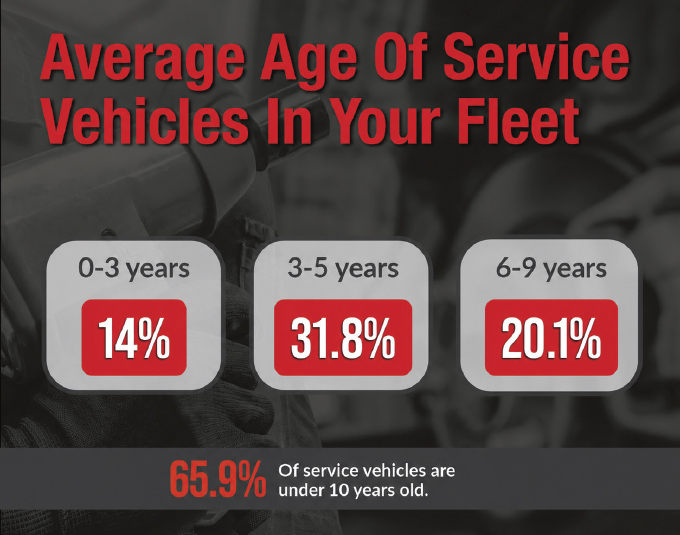
A big aspect of fleet management is how long companies keep their service vehicle in operation. Overall, 66 percent of vehicles are under 10 years old. The average age for fleets varies, with 31.8 percent averaging three to five years, 20.1 percent six to nine years, 17.9 percent 10 to 14 years, and 14 percent under three years. It is also important to note that 64.9 per cent of respondents prefer to buy new vehicles for their fleet rather than used.
How many trucks does each fleet have? According to the survey, 73 percent said that their service truck fleet consists of one to five trucks. In the future, 67 percent of respondents plan to maintain the same fleet size they have currently.
The use of service vans in the industry has been in decline for some time. As 33 percent of respondents said they have service vans in their fleet (down from 40 percent in 2024). Those who are using vans currently, 78 percent expect number to stay the same, while 20.7 percent believe numbers will increase. Vans are a secondary or situational choice for fleets, with trucks being the primary choice.
Electric vehicles have been increasing in numbers over the past few years, with a decrease in options available over the last couple of years, because of a variety of factors. With EVs being a more viable options in the recent past, with higher ranges, more charging stations, and lower charging times. Many are still skeptical with only 5.7 percent of respondents planning to purchase an electric vehicle. With concerns including range limitations (66.7 percent), followed by charge time (57 percent), charging availability (55.3 percent), and costs (49.1 percent).
EQUIPMENT AND AIR COMPRESSORS
Moving over to the equipment that is used on the vans and trucks, unsurprisingly, the most important piece of equipment for respondents was an air compressor (35 percent), while another 41.3 percent said all equipment is equally important in an integrated setup. Other important equipment that ranked lower included multi-power systems, welders, cranes, and generators. In all, 45.8 percent of respondents have an air compressor on every service vehicle, while 11.2 percent had them on most vehicles.
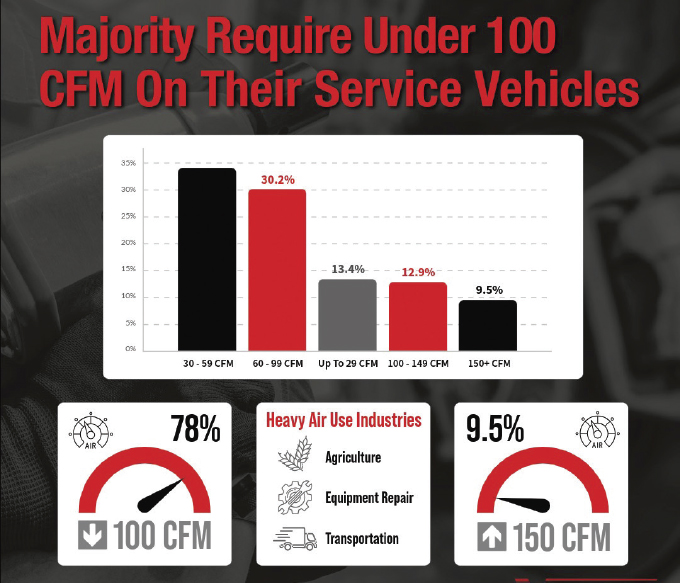
When asked “what CFM range best fits your requirements for your service vehicles?” The top answer was 30-59 CFM (34.1 percent), followed by 60-99 CFM (30.2 percent), up to 29 CFM (13.4 percent), 100-149 CFM (12.9 percent), and over 150 CFM (9.5 percent).
Also, most respondents prefer to use rotary screw air compressors (73 percent) over a reciprocating air compressor for their service vehicles. Rotary screw air compressors are valued for their performance (reliability and efficiency), size (compact design), quality (lower maintenance needs), continuous airflow, and weight.
“What stands out in our build data is how broadly rotary screw compressors are being adopted. They are not limited to large national fleet programs. We also see strong demand from customers who purchase only 1 to 5 trucks per year,” said Sondra Kirby, marketing manager, Summit Truck Equipment. “For a small business, every service truck has to earn its place. One truck may support a significant share of the company’s field work, so uptime, efficient use of space, and dependable air delivery are critical. The continued preference for rotary screw technology reflects the value businesses of every size place on keeping technicians productive and work moving in the field.”
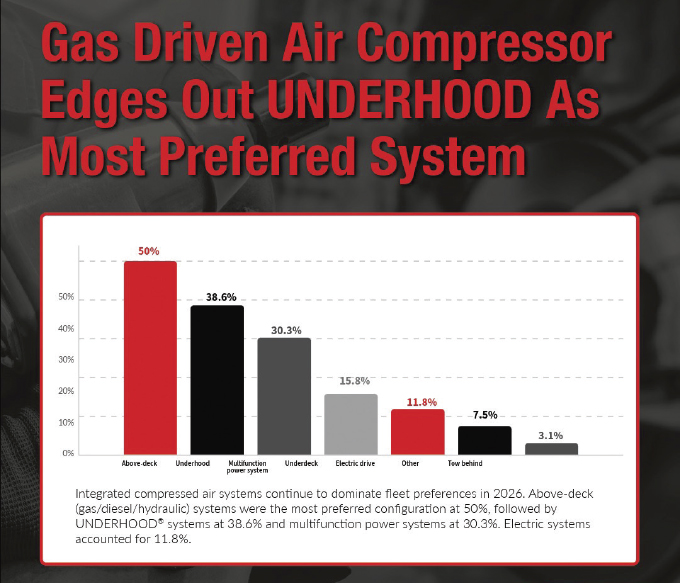
When looking at the types of air compressor system respondents prefer on service vehicles, the top three were above-deck (gas, diesel, hybrid) at 50 percent, Underhood (38.6 percent), and multifunction power system (30.3 percent).
Other tool findings included: the most used pneumatic tools, which are impact wrenches (86 percent), ratchets (54.8 percent), grinders (47.8 percent), percussive (45.7 percent), drills and screwdrivers (43 percent), sanders (33 percent), saws (15 percent), concrete breakers (eight percent), and other (12 percent). While battery-powered tools are gaining acceptance, only 30.3 percent of respondents believe it is likely to replace air tools, with 15.4 believe it is very likely; 33.4 are neutral, and 16.5 percent think it is unlikely to happen.
IMPACT ON BUSINESS
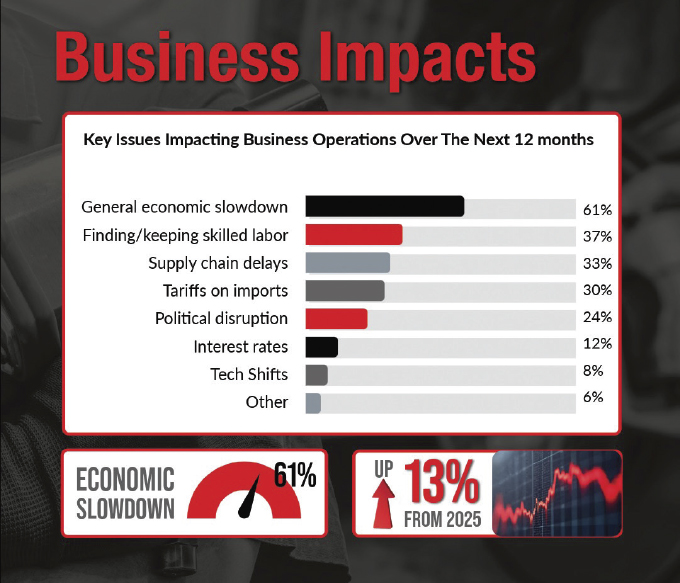
For the 2026 edition of the survey, respondents cited the general economic downturn (61 per cent) as the key issue impacting their business in the next 12 months. This was followed by finding/keeping skilled labour (37 percent), supply chain delays (33 percent), and tariffs on imports (30 percent). This demonstrated that many businesses have shifted their focus from labor concerns to economic concerns.
“The easing of labor shortages is an encouraging sign for service truck and van businesses, providing greater stability for recruitment, training, and workforce development. While economic and market pressures remain, companies that continue investing in skilled people, efficient equipment, and adaptable fleet strategies will be well positioned for long-term growth,” said Rob Beukema, president, Work Truck West.
LOOKING TO THE FUTURE
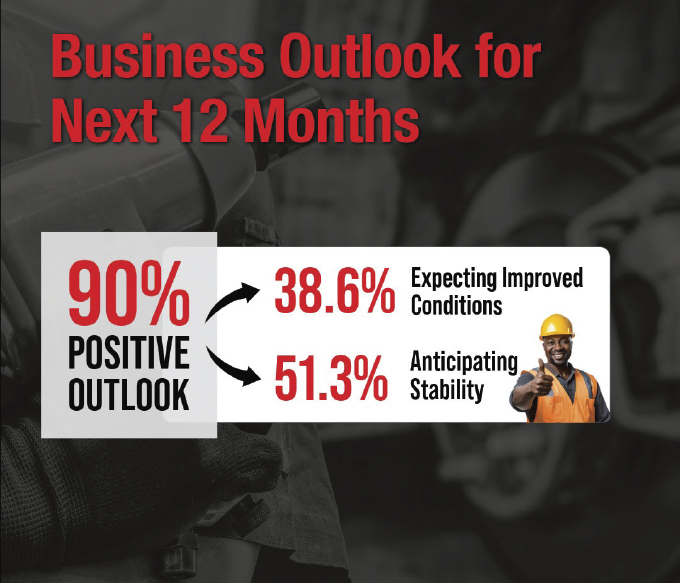
What does the future hold for businesses? Respondents were cautiously optimistic, with 38.6 percent believing that business spending for the next 12 months will increase, while 51.3 percent believing that they will stay the same, and only 10.1 pr cent thing they will reduce spending. saying they think they will get better. However, just over a quarter (26 percent) look at the next 12 months as being worse.
“We want to extend our sincere thanks to everyone who took the time to participate in the State of the Mobile Compressed Air Industry survey. Your responses have provided invaluable insight into the challenges, priorities and emerging trends shaping the compressed air market today. By sharing your firsthand experiences, from requirements on service fleets to the growing emphasis on energy-efficient systems, you have helped create a clear picture of where our industry stands and where it is headed. Your input will guide our ongoing efforts to develop solutions that deliver unmatched reliability, performance, and value,” said Tod Gilbert, President of VMAC.
about the author
Mario Cywinski is the editor of Modern Work Truck Solutions and has worked in the automotive industry for over 20 years, both as an automotive journalist and working for a local dealership. He is a member of the Automobile Journalist Association of Canada. He can be reached at mario@mwsmag.com.