
From roadside repairs to remote jobsites, technicians rarely work on perfectly level ground. As mobile workspaces continue to evolve, drawer retention technology is becoming an increasingly important consideration for improving safety, efficiency, and workflow.
One call may require servicing equipment along the shoulder of a highway, while the next could take place on a gravel access road, a construction site, a farm, or a utility right-of-way. These locations have one thing in common: they are seldom level.
While service trucks and mobile workshops have become increasingly organized over the past decade, uneven terrain continues to present unique challenges. One often-overlooked issue is keeping storage drawers securely open while technicians access tools and equipment. When drawers unexpectedly slide closed, technicians are forced to stop what they’re doing, reopen the drawer, and continue working. Although it may seem like a minor inconvenience, these repeated interruptions can add up over the course of a busy workday.
As fleets continue investing in productivity, ergonomics, and technician safety, storage systems are evolving beyond simply holding tools. Today’s designs are increasingly focused on improving the overall mobile workspace experience.
REALITY OF FIELD SERVICE
Unlike a traditional workshop, mobile technicians rarely have the luxury of working on smooth, level concrete floors. Whether servicing heavy equipment, utility infrastructure, municipal fleets, construction machinery, or commercial vehicles, technicians often park wherever the job requires.
Sloped driveways, crowned roads, gravel pull-offs, uneven pavement, and off-road jobsites all become part of the workspace. These conditions influence everything from technician footing to how equipment performs inside the vehicle.
Storage systems are directly affected by gravity. When a vehicle is parked on an incline, the weight of fully loaded drawers can cause them to drift, or slide closed while the technician is retrieving tools. The heavier the drawer and the steeper the terrain, the more noticeable the effect can become.
SMALL INTERRUPTIONS HAVE A BIG IMPACT
Productivity isn’t always lost through major equipment failures. More often, it’s the accumulation of small inefficiencies throughout the day that impacts technician performance.
Unexpected drawer movement interrupts workflow by requiring technicians to repeatedly reopen drawers while searching for tools or parts. In some situations, drawers closing unexpectedly can also increase the likelihood of pinched fingers or create unnecessary distractions when technicians are focused on the repair itself.
As service organizations continue looking for ways to maximize technician efficiency, reducing these everyday frustrations has become an important consideration when specifying service vehicle equipment.
STORAGE DESIGN HAS CONTINUED TO EVOLVE
The demands placed on service vehicles have changed significantly over the years. Modern technicians carry more specialized tools, diagnostic equipment, battery-powered tools, and replacement parts than ever before. At the same time, fleet managers are placing greater emphasis on organization, accessibility, and long-term durability. This has driven continued innovation in storage system design.
Historically, many drawer systems relied primarily on friction, roller detents, or basic latch mechanisms to help drawers remain in position. While these approaches perform well in many situations, uneven terrain and heavier drawer loads can reduce their effectiveness.
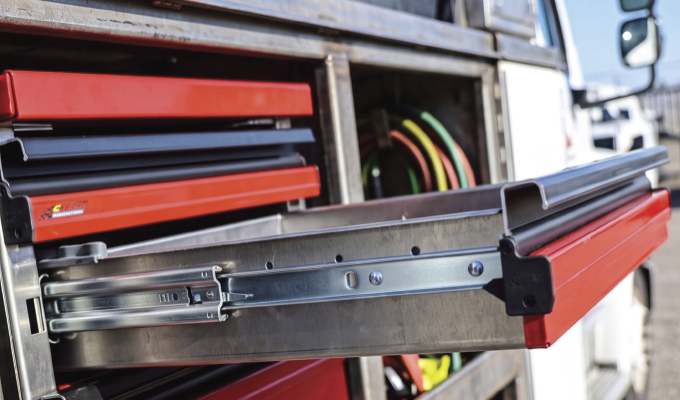
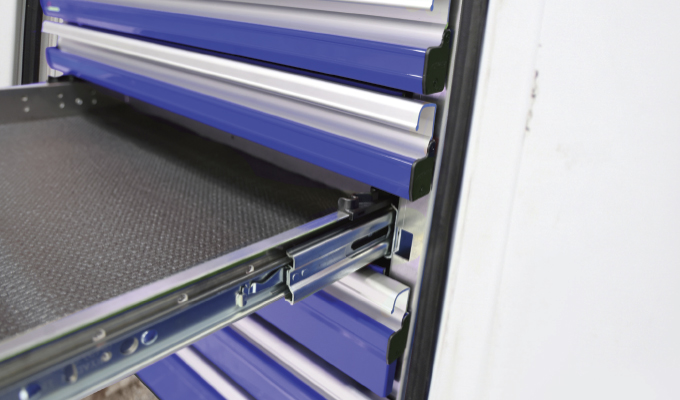
In response, manufacturers have begun developing positive mechanical drawer retention systems designed specifically for mobile work environments. Rather than relying solely on friction, these systems mechanically engage when a drawer reaches full extension, helping keep it securely open until the user intentionally closes it.
The goal isn’t simply to add another feature, it is to make the mobile workspace function more predictably in real-world conditions.
WHAT FLEET MANAGERS SHOULD CONSIDER
When evaluating storage systems for service trucks, utility bodies, enclosed trailers, or other mobile workspaces, drawer retention is becoming another factor worth considering alongside capacity, organization, and durability.
Fleet managers may benefit from asking several questions when comparing storage solutions.
- Does the drawer remain securely open on uneven terrain?
- Is the retention system simple and intuitive to operate?
- Does it require additional buttons or release levers?
- Has the system been tested under realistic working conditions?
- Will it continue performing reliably under heavy drawer loads and repeated daily use?
Answering these questions can help ensure technicians spend less time managing their storage system and more time completing repairs.
INNOVATION DRIVEN BY REAL-WORLD CHALLENGES
As manufacturers continue refining mobile storage systems, new technologies are emerging to address the everyday challenges technicians face in the field.
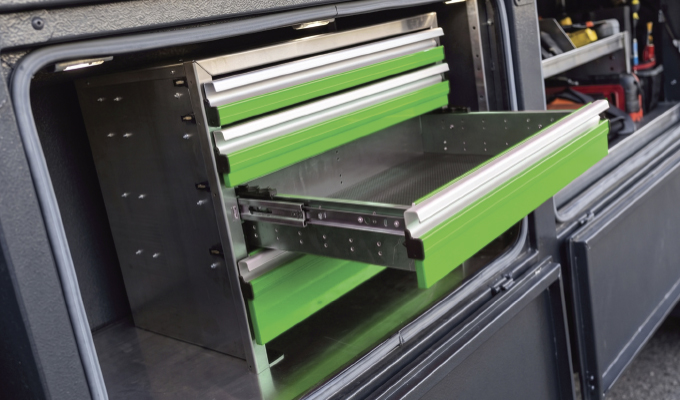
One example is CTech Manufacturing’s patent-pending LocOut Technology, developed as an enhancement to the company’s MotionLatch drawer systems. Designed for service trucks, utility bodies, enclosed trailers, and mobile workshops, the system uses a positive mechanical hold-open mechanism that automatically engages when the drawer reaches full extension. Once engaged, the drawer remains securely open until the user intentionally pulls it fully to the stop, allowing the mechanism to reset naturally for normal closing.
The technology was developed specifically to address the challenges technicians encounter when working on sloped driveways, gravel pull-offs, crowned roads, and other uneven terrain. Rather than changing how users interact with the drawer, the system was designed to operate seamlessly as part of the normal workflow.
While manufacturers may approach drawer retention differently, the broader trend reflects the industry’s continued focus on improving the usability of mobile workspaces through thoughtful engineering rather than unnecessary complexity.
LOOKING AHEAD
Mobile service vehicles have evolved into highly organized, purpose-built workspaces that allow technicians to complete increasingly complex repairs wherever the job takes them. As expectations continue to grow, even seemingly small improvements in storage functionality can make a noticeable difference throughout the workday.
Drawer retention may not be the first feature considered when outfitting a service vehicle, but for technicians working on uneven terrain every day, it can improve confidence, reduce interruptions, and support a more efficient workflow.
As the mobile workspace continues to evolve, innovations that solve practical, everyday challenges will remain an important part of helping technicians work safer, smarter, and more efficiently, regardless of where the job takes them.
about the author
Kirstin Christophersen is the marketing manager at CTech Manufacturing, a Wisconsin-based manufacturer of premium aluminum storage solutions for service vehicles, trailers, garages, and commercial workspaces. She works closely with engineering, product development, and customers to communicate innovations that improve organization, efficiency, and productivity in mobile work environments.