

Fleet managers today face pressures that would have been difficult to imagine a decade ago. Acquisition costs have climbed sharply. Supply chain constraints have left a lasting mark on budgets and lead times. The result is that fleets across the work truck industry are holding onto vehicles longer than ever. Rotation cycles that averaged seven to 10 years are stretching to 12 and beyond. A fleet that used to plan for one battery replacement per vehicle is now budgeting for two or three. And every additional year a truck stays in service, the cumulative toll of unnecessary engine idling becomes more consequential.
That’s the context behind a significant expansion of Vanair’s EPEQ Electrified Power Equipment ecosystem. Five new products join the platform: a 12-volt battery and inverter system, the EPEQ Power Center core power module, the EPEQ Solar Assist vehicle solar system, a chassis-mounted configuration of the Velion 50kW DC fast charger and upgraded 48-volt ELiMENT batteries with IP67 protection. Each addresses a different challenge, but together they form an integrated power architecture.
REAL COST OF IDLING
The conversation around idle reduction used to center on fuel savings and emissions. Those remain valid, but they’re no longer what drives most fleet managers to act. The most urgent issue in today’s business environment is asset protection.
Consider what happens inside a work truck that idles for hours each day. The engine accumulates hours and wear without covering productive miles. Diesel particulate filters and emissions components degrade faster. Alternators work overtime to keep up with growing electrical loads from telematics, GPS, dash cameras, and onboard control systems. Starting batteries, already strained by these parasitic draws, discharge more deeply and frequently, shortening their useful life. The downstream effects are predictable: more battery replacements, more roadside service calls, more unplanned downtime, and higher per-vehicle maintenance costs.
For a fleet holding trucks for longer periods, every associated cost compounds. A battery failure that might have been a minor inconvenience in year four becomes a pattern by year eight. Batteries drain silently. By the time a technician gets a no-start call, the damage to the battery and the fleet’s schedule is already done.
A Platform, Not a Product
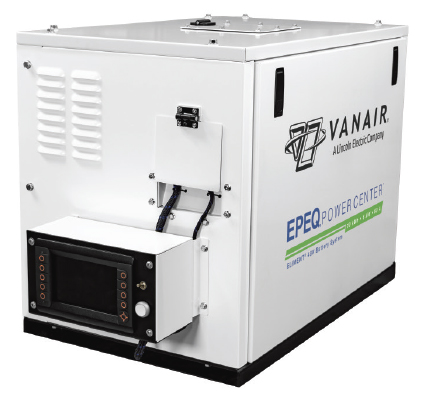
The 2026 expansion of the EPEQ platform broadens the ecosystem. For fleets that need full 48-volt capability, the new EPEQ Power Center consolidates ELiMENT batteries, inverters, a DC-DC converter and shore-power charging into a single enclosure. The Power Center does not include a compressor or welder, it is a dedicated power hub to which operators connect only the EPEQ-driven accessories they need: compressors, the EPEQ EPTO Hydraulic System, a welder or some combination.
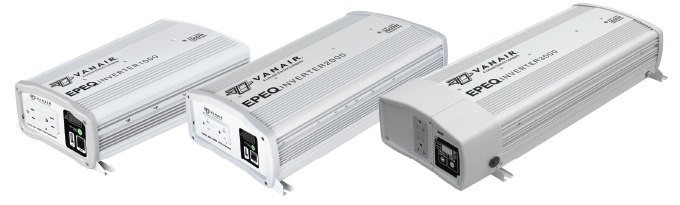
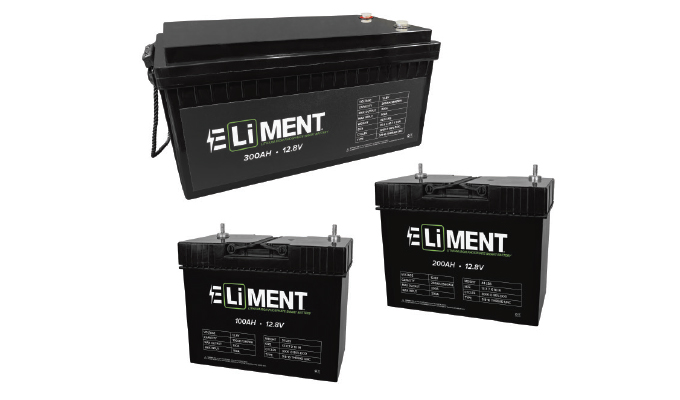
For fleets operating lighter-duty vans, delivery vehicles, and custom-upfitted service trucks, the new EPEQ 12-volt line opens a market segment that previously had few integrated options. It pairs ELiMENT 12-volt lithium iron phosphate batteries in 100 Ah, 200 Ah and 300 Ah configurations with pure sine wave inverters in 1,000W, 2,000W and 3,000W models. The batteries provide a dedicated, isolated power source that prevents auxiliary loads from depleting the vehicle’s starting battery, allowing crews to charge cordless tools, run work lights, power laptops, and operate 120-volt devices including a 5 CFM air compressor without turning the key. For a plumbing contractor running a service van or a telecom technician in a cargo body, this is the difference between arriving at the next call with a reliable truck and phoning dispatch for a jump-start.
PUTTING SOLAR TO WORK ON WORK TRUCKS
Added to the ecosystem is Solar Assist, a patented, flexible solar panel engineered specifically for vocational truck applications. Many previous solar solutions for commercial vehicles have been hampered by fragile rigid panels, complicated installations and underwhelming real-world performance. The panels are just 1/8-inch thick, mount with a peel-and-stick adhesive requiring no drilling. They utilize a shade-resilient mesh grid with more than 2,100 conductive pathways, producing meaningful energy in the low-angle, diffuse and partially shaded conditions that are a reality for a panel on a moving truck.
Every work truck draws parasitic power when parked. Telematics modules, GPS units, tire pressure monitors, and security devices never fully power down, pushing batteries into progressively deeper states of discharge and accelerating sulfation. Solar Assist counteracts that process by maintaining a higher state of charge throughout the day. Fleet data shows consistent solar battery tending can extend battery life by up to 200 percent, potentially eliminating an entire replacement event per vehicle over a rotation cycle.
Each system includes Maximum Power Point Tracking (MPPT) charging that harvests up to 45 percent more energy than standard Pulse Width Modulation (PWM) controllers. Solar Assist supports both EPEQ platforms and can be ordered directly on Vanair equipment, arriving factory-installed and wired using patent-pending equipment-mounted solar architecture before the machine reaches the upfitter. Since the solar system is integrated with the equipment rather than the chassis, it transfers seamlessly when a body is remounted onto a new vehicle.
MOBILE DC FAST CHARGING WHERE THE GRID CAN’T GO
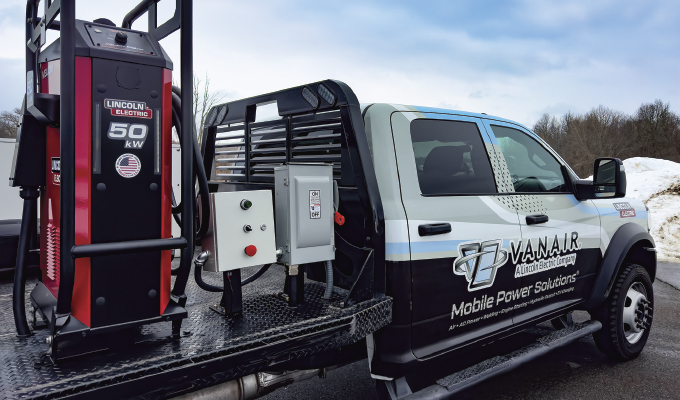
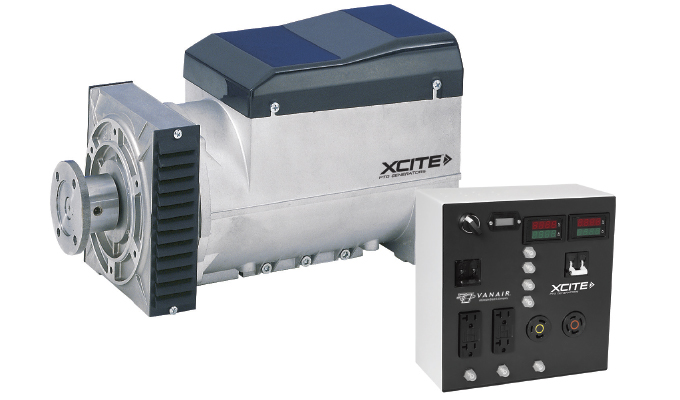
As municipalities and utilities continue integrating electric vehicles into their fleets, one question keeps surfacing: what happens when EV batteries become depleted in the field? A truck-mounted configuration of the Velion 50kW DC fast charger, paired with a Vanair Xcite PTO-driven 33kW generator, provides the answer. The system enables DC fast charging anywhere the truck can drive. Trailer-mounted alternatives can cost $150,000 to $200,000 and require a dedicated vehicle. The Velion chassis-mount adds fast-charging capability to a multi-purpose service truck. It features CCS1 and NACS connectors, a NEMA 3R enclosure, IK08 impact rating and can be removed for use as a stationary charger.
TOUGHER BATTERIES FOR TOUGHER ENVIRONMENTS
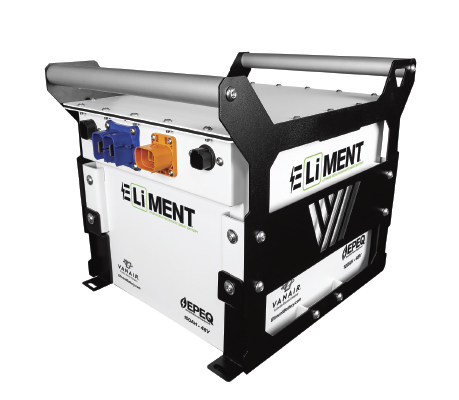
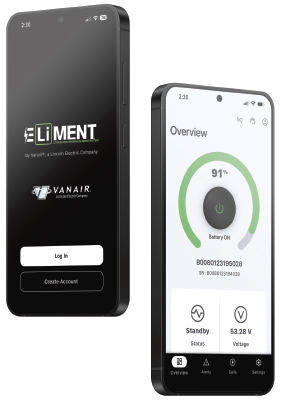
Underpinning all of this is an upgrade to the 48-volt ELiMENT lithium iron phosphate batteries. The new design carries an IP67 rating for protection against dust and temporary water immersion, with mounting configurations that allow installation in under-chassis and frame-rail positions. An updated battery management app gives maintenance teams real-time visibility into battery health, state of charge and diagnostics from a mobile device.
CONTROL WHAT YOU CAN CONTROL
The economics of fleet management are not getting simpler. Trucks cost more, last longer and carry more technology than at any point in this industry’s history. What we can control is how efficiently we power them when the engine doesn’t need to be running. That’s the opportunity, and it’s a bigger one than most fleets realize.
about the author
Dean Strathman is vice president of sales for Vanair, a Lincoln Electric Company headquartered in Michigan City, Indiana. He joined the company in 2009 when Vanair acquired Air N Arc and has held progressively senior sales leadership roles, including national sales manager and vice president of abovedeck sales, before being named to his current position. Strathman has played a central role in the development and commercialization of the EPEQ Electrified Power Equipment ecosystem and the strategic integration of Lincoln Electric technologies into Vanair’s product line. To learn more, visit www.vanair.com/epeq-electrified-power-equipment.